



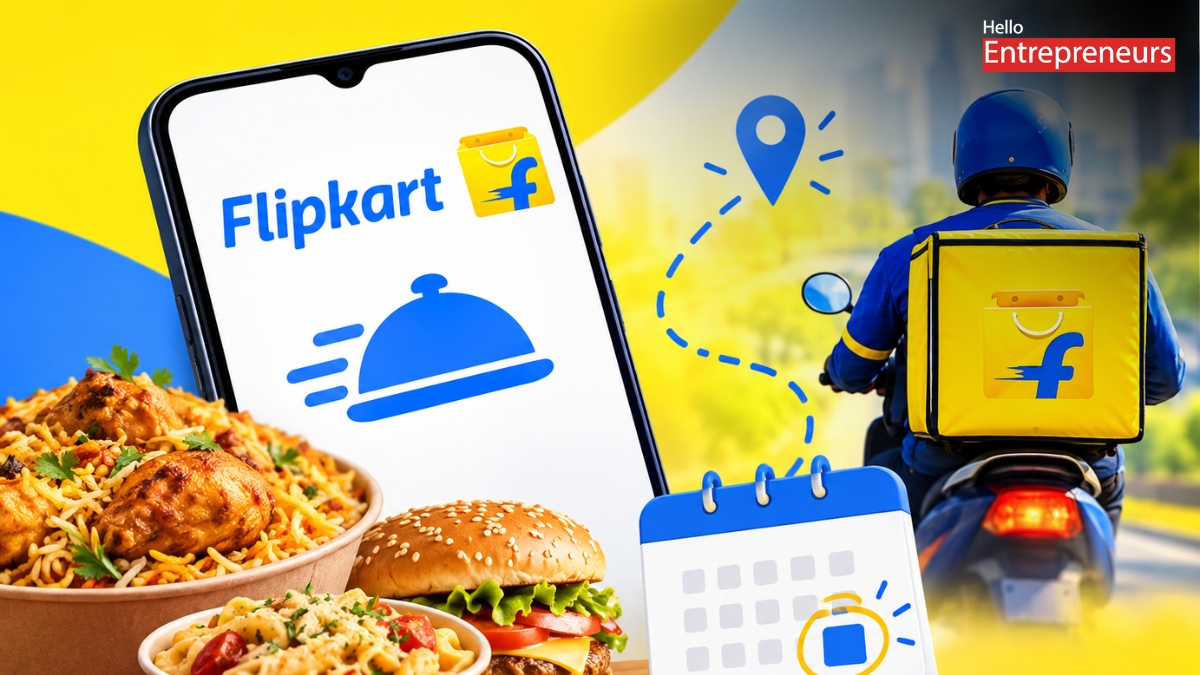
Flipkart, under Walmart’s ownership, is growing its in-house food delivery trial, Eat-in by Minutes, now reaching more than 8,000 employees in Bengaluru. People close to the project told TechCrunch the company aims for a public launch by the end of October. If that happens, it would pit Flipkart directly against Zomato and Swiggy—the top dogs in India’s food delivery scene.
Flipkart hasn’t shared any official launch date yet, and when Inc42 reached out, the company stayed silent.
So, what’s going on with Eat-in by Minutes? Right now, only Flipkart employees can use it. The feature even has its own tab in the Flipkart app, next to Flipkart Minutes (their quick-commerce play) and travel bookings. The pilot started small with just a few hundred participants but has quickly swelled to over 8,000 employees.
The service pulls in restaurant options from the government-backed Open Network for Digital Commerce (ONDC) and from eateries Flipkart signs up on its own. Deliveries go out through Ekart, Flipkart’s logistics arm, with its own dedicated “Eat-in by Minutes” riders—no overlap with the quick-commerce delivery team. People have spotted these riders in branded jerseys zipping around Bengaluru.
To encourage employees to try the pilot, Flipkart has dangled discounts and extra SuperCoins, according to promo materials Entrackr cited.
There’s already talk about taking this wider. Sagar Daryani, president of the National Restaurant Association of India, told TechCrunch that Flipkart expects a public launch by the end of October and is thinking big—expanding to five or six more cities by late 2026. Kalyan Krishnamurthy, Flipkart’s group CEO, publicly confirmed their food delivery ambitions back in July. They’ve been testing the idea internally since at least September, ramping up with staff before opening to all shoppers.
Why should restaurants care? Flipkart’s main pitch is price. Daryani said they’re offering restaurants a base commission of about 10%, while Zomato and Swiggy usually take 20%-25%. Of course, the commission isn’t the only headache for restaurants—advertising, discounts and platform promos add up. Daryani claimed that on other platforms, restaurants can end up spending up to half of an order’s value, but Flipkart’s full costs might land closer to 15%-16%.
He didn’t hold back: “Monopoly is bad, but duopoly is more pathetic.” He also thinks Flipkart’s experience with quick-commerce could let them run their food delivery leaner and smarter.
That lower-cost angle could get attention from restaurants tired of the current two-player squeeze. Others have tried new approaches—Rapido’s Ownly doesn’t take any commission and Swiggy recently launched Toing, which focuses on affordable meals.
Still, breaking into this market won’t be a walk in the park. Zomato and Swiggy have scale, restaurant partnerships, delivery fleets, and customer habits on their side. Many others have come and gone—Amazon gave up on food delivery in Bengaluru after two years, Uber sold its India Eats business to Zomato, and Google’s Areo didn’t catch on either.
According to Bernstein, India’s food delivery market is growing at around 18%-20% annually. Saving customers ₹20-₹30 per order might not be enough to shift loyalty from brands like Zomato or Swiggy—especially if they counter with their own discounts.
Flipkart’s real edge is its broad commerce ecosystem—millions of shoppers, a massive logistics backbone, and quick-commerce all under one roof. That could help them cross-sell food orders, though they still need to prove they can turn regular shoppers into food delivery fans.
The big question now: will Flipkart actually launch for the public by October’s end, or will things stay internal and Bengaluru-only for a while? Their ability to bring more restaurants on board, keep the Ekart delivery fleet reliable, and compete on low commissions (without massive discounts) will decide whether Eat-in by Minutes becomes a genuine third option, or just another short-lived experiment in India’s cutthroat food delivery market.

