



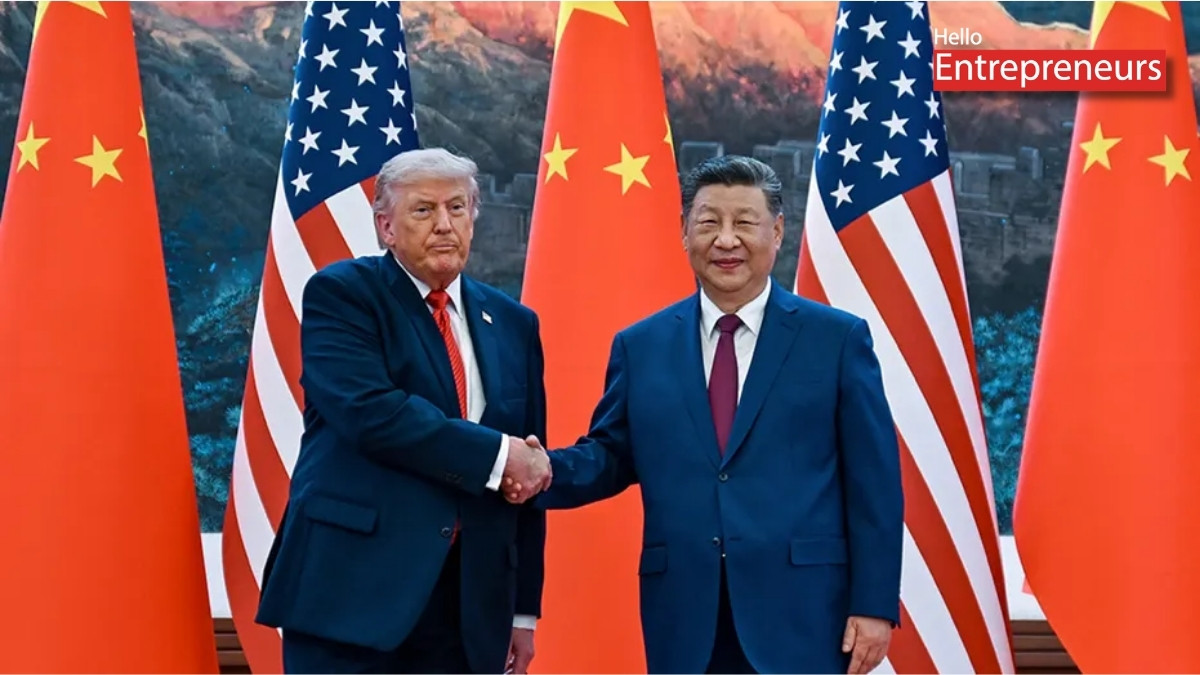
New Delhi: Aviation has always been a barometer of international politics and trade, and this remains true in the modern era. The demand for major aircraft is seldom a simple business deal and is an expression of greater economic co-operation between governments. The same dynamic was seen again this week when China announced a huge deal with Boeing after the US President, Donald Trump, and the Chinese President, Xi Jinping, met in Beijing.
As part of a wider trade deal agreed to during Trump’s visit, China pledged to purchase 200 Boeing planes. China’s Commerce Ministry confirmed the news, adding the U.S. would also guarantee supplies of aircraft engine parts and related components.
Meanwhile, both nations agreed to further discuss extending the tariff truce and initiated negotiations to lower tariffs on at least $30 billion in goods. It is the latest move in an effort by Washington and Beijing to ease economic ties that have been strained for years by trade conflict, tariffs and supply-chain tensions.
The Boeing deal was one of the highlights of Trump’s trip, the president said. He told reporters on Air Force One after departing China that they had “made a lot of great trade deals” — more than 200 planes for Boeing “promised,” which would “be by far” the largest order ever.
Boeing’s timing is key. The company has been struggling to overcome production issues, supply chain disruptions, and growing competition from Airbus in Europe for several years. Reconstructing business momentum in one of the world’s largest markets for aviation products and services – China – has consequently become a growing concern.
China is a key player in the future of global aviation. In sum, the country is expected to account for almost 20% of global aircraft demand over the next 20 years, as air travel continues to grow in Asia. In the past few years, as tensions between the United States and China have risen, Chinese airlines have been among Boeing’s biggest customers.
Boeing confirmed the talks in a statement.
They were able to reopen the China market to orders for Boeing aircraft, and they had a very successful trip to China,” the company said. The contract also contained “an initial commitment for 200 aircraft,” and Boeing was confident that “further commitments will follow after this initial tranche,” it added.
The linkage between the business and diplomatic worlds is what is unique. Boeing CEO Kelly Ortberg was part of Trump’s US delegation during the visit to China. In addition, prominent tech leaders like Elon Musk and Jensen Huang were part of the delegation.
Their presence indicated the broader economic agenda of the meetings. The two countries no longer talk about only manufacturing or agricultural exports. The two countries now have new critical areas in play: semiconductors, artificial intelligence, electric vehicles, and access to critical minerals.
China’s Commerce Ministry said both sides would keep exploring ways to lower tariffs and further stabilize trade. An earlier meeting of US and Chinese officials in Kuala Lumpur had already agreed to a tariff truce which was to continue until November this year.
That earlier agreement involved lower tariffs on some Chinese products, as well as a temporary reprieve from curbs on rare earth minerals and magnets. The materials have become of great strategic significance because they are widely used in electric vehicles, electronics, renewable energy systems, and defense equipment.
But the Boeing deal is in many respects a step toward pragmatic cooperation between the two governments in the absence of political unity. Washington and Beijing have had strained trade ties since tensions over tariffs escalated under Trump’s first presidency. The relationship is dynamic and has seen various temporary agreements, but issues related to access to technology, industrial policy, and national security remain sources of tension between the two countries.
The aviation industry is also starting a new phase of its development. IATA says global passenger traffic is now mostly back to 2019 levels, and airlines in Asia and the Middle East are still buying despite expected growth.
In China, the expansion of aircraft purchases is linked to broader objectives in the tourism and business travel sectors, as well as international connectivity. As outbound tourism has picked up, Chinese carriers have continued to add routes year on year.
It’s unclear whether the deal will eventually be expanded to the larger 750-aircraft pact Trump referred to. Nonetheless, the new agreement is one of the more direct clues in recent months that the U.S. and China are trying to restore a modicum of economic predictability — even as global geopolitical tensions remain unresolved.