



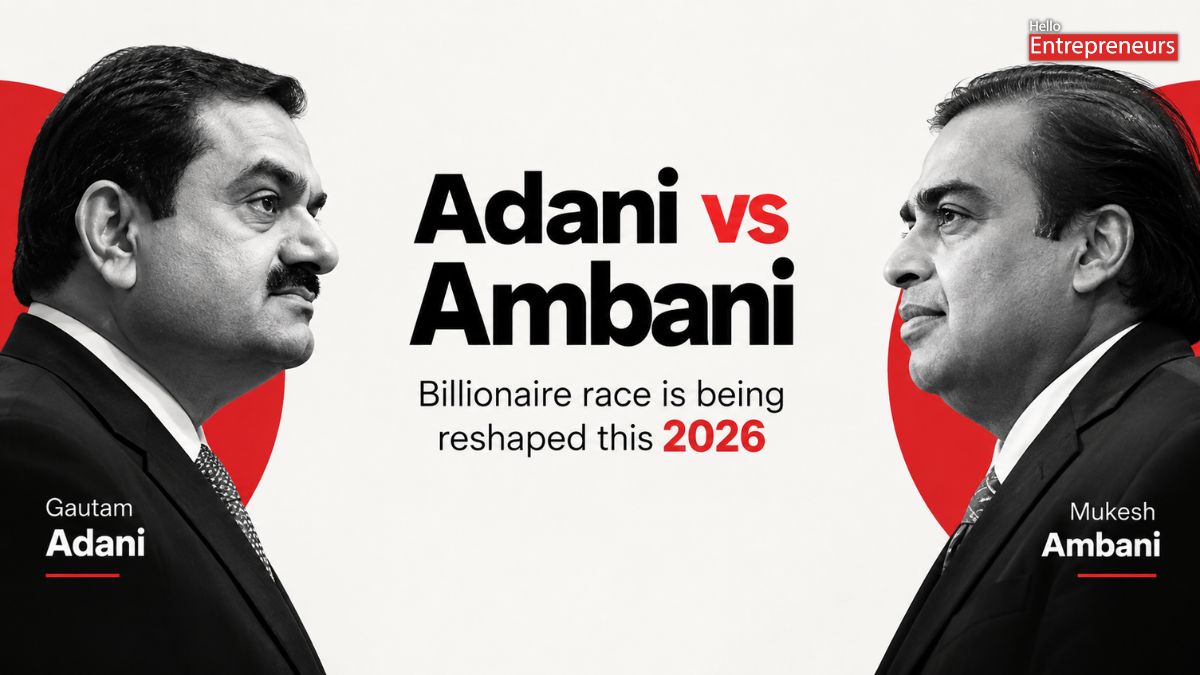
New Delhi: India’s long-running billionaire rivalry between Gautam Adani and Mukesh Ambani is entering a new phase in 2026. The competition is no longer simply about who has the higher net worth. It is increasingly about who can build the strongest position in India’s next big growth industries.
Mukesh Ambani’s Reliance has built a diversified empire covering telecom, retail, energy, media and digital services. Gautam Adani, meanwhile, has expanded aggressively across ports, airports, power, renewable energy, transmission, cement and infrastructure.
Reliance remains one of India’s largest corporate groups by scale. For FY2025-26, Reliance Industries reported gross revenue of ₹11.76 lakh crore, EBITDA of ₹2.08 lakh crore and profit after tax of ₹95,754 crore. The company also invested ₹1.44 lakh crore during the year.
Its consumer businesses are becoming increasingly important. Jio had more than 524 million digital subscribers, while Reliance Retail recorded gross revenue of ₹3.71 lakh crore in FY26, up 12.1% year-on-year.
Adani’s growth story is built differently. Instead of creating a consumer-facing ecosystem on the scale of Jio and Reliance Retail, the group has focused heavily on physical infrastructure and energy.
Adani’s portfolio had ₹55,852 crore in cash as of March 31, 2026, while portfolio-level net debt to EBITDA stood at 3.3x. The group said equity remained its primary source of funding, accounting for 60% of its asset base.
The two groups are now moving into areas that could define India’s next decade.
Reliance is investing in clean energy, digital infrastructure, artificial intelligence, retail and telecommunications. Its Jio network had 268 million 5G subscribers by March 2026, while fixed broadband subscribers reached 27.1 million.

