



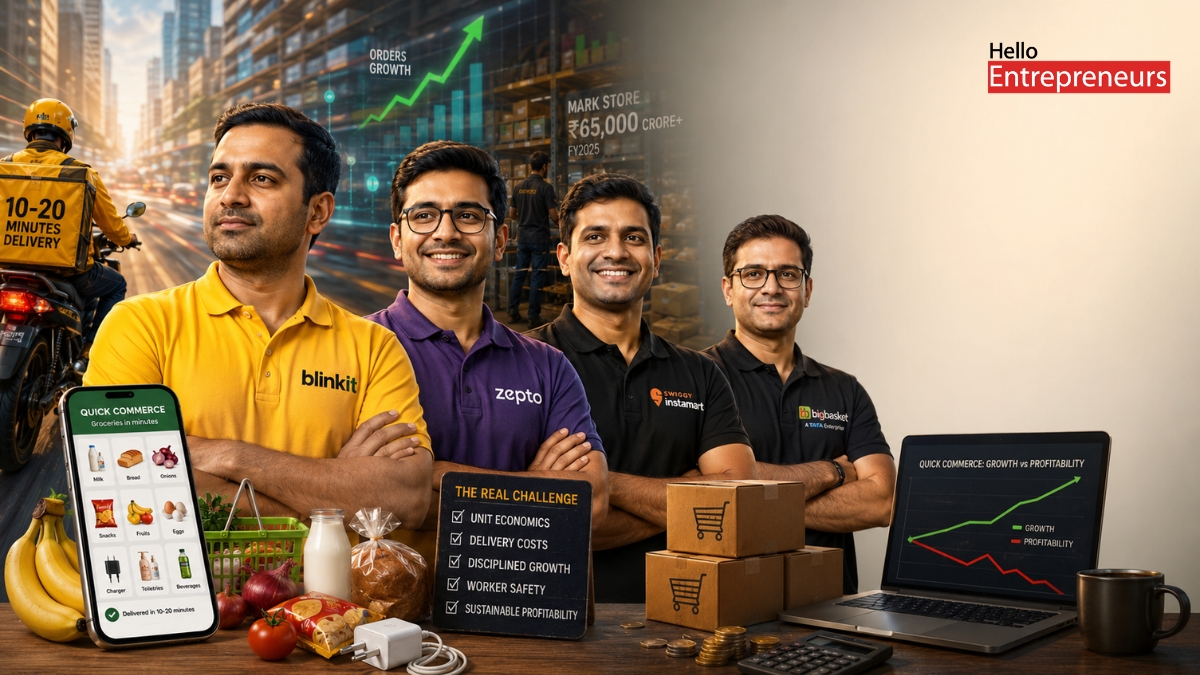
Grocery shopping for India’s urban shopper has shifted from a chore to a reflex. A packet of milk, bread, onions, snacks even a charger , all of it now sits one tap away. That is the promise of quick commerce: groceries in minutes, not hours. But the speed hides a harsher reality. This industry is booming but it is still grappling with a fundamental question. Can it ever make real money?
India’s quick-commerce market was between ₹64,000 crore and ₹65,000 crore in FY2025, and Reuters said the sector had grown to about $11.5 billion by January 2026. It is not a niche anymore. It is a serious business. Blinkit, Zepto, Swiggy Instamart and BigBasket are all vying for the same urban customer, while Dunzo has already become a cautionary tale of what happens when ambition outpaces balance sheets.
The model is simple on the surface. Build small dark stores close to dense neighbourhoods. Stock them with high-velocity items. Dispatch a rider instantly. Deliver within 10 to 20 minutes. But the economics are unforgiving. Every new store costs money. Every short trip costs money. Every discount costs money. And every order is too small to cover the full delivery cost.

Blinkit illustrates both the promise and the peril of this model. By the end of 2024, it had surpassed 1,000 dark stores, and Zomato invested another ₹1,500 crore into its venture. Yet Blinkit still posted an operational loss of ₹103 crore in the October-December quarter. That is the real story of quick commerce in India: scale is growing, but profitability is still far off.
Zepto has become the other big name in the space. It raised $450 million at a $7 billion valuation in 2025, after previous valuation rounds had valued it at $5 billion. The company has been able to announce massive order growth, too, going from 500,000 daily orders to 1.7 million in roughly five quarters. That is a dream. Growth alone does not address the problem, however. More orders can still mean more losses if every delivery is underpriced.
Swiggy Instamart is telling the same story in a different voice. Swiggy’s quick-commerce revenue doubled to Rs 806 crore, but the business is still loss-making. Reports showed the segment loss was approximately Rs 797 crore in one quarter, even as the company expanded its dark-store count to 1,062 stores. More revenue does not always mean less pain. In this market, growth and loss often travel together.
BigBasket, a venture of Tata, is trying to take a more careful route. Reuters reported that it plans to roll out 10-minute food delivery nationwide by the end of FY2026 and to expand its dark-store count from around 700 to 1,000-1,200. Unlike in the early days of the sector, the mood in large corporate owners is changing. The message is no longer “grow at all costs.” It is “grow, but prove the unit economics.”

Then there is the warning tale. That is Dunzo. Reliance had to write off its investment in the company after Dunzo struggled with massive losses and rising per-month expenses to as much as Rs 100 crore. It is a reminder that quick commerce is not just a race of speed. It is a race of cash, discipline and patience. Those companies that ignore this generally vanish quietly.
Consumers are also evolving the game. The era of lean, free, frictionless delivery is ending. In Bengaluru, the outlets reported that a large set of platforms are now expecting customers to spend around ₹199 or more to save them the ₹30 delivery charge. That is a small number, but it changes the dynamics. A customer who was looking for milk and bread now adds a few more items. The basket gets bigger not because the family needs more, but the app makes convenience a luxury service.
This is where the industry is growing up. The old promise was speed. The new fight is around unit economics. It means higher average ticket sizes, tighter inventory management, better routing and delivery density, and fewer fairy subsidies. It also means accepting a bitter truth: the customer may love 10-minute delivery, but not every order needs to be sold at a loss forever.
There is another challenge now too: regulation and worker safety. In January 2026, Reuters reported that Indian government asked firms to step back from promoting grocery delivery as “10-minute” service after road safety concerns. Gig workers have also raised alarms about falling incentives, algorithmic pressure and unsafe riding conditions. The industry’s speed promise is not just about business. It is a public issue.
That’s why the quick-commerce war might not end with a winner-take-all. It might end with a smaller group of players, each pushing for greater efficiency and greater discipline. Goldman Sachs has estimated that India’s top 50 cities could cater to a very healthy market by 2030, but only a handful of profitable players. That makes sense. The market is big enough for a few survivors, but not for endless insanity.
The bigger shift is this: India’s quick-commerce story is moving from magic to math. Speed got these companies noticed. Efficiency will determine who survives.

