



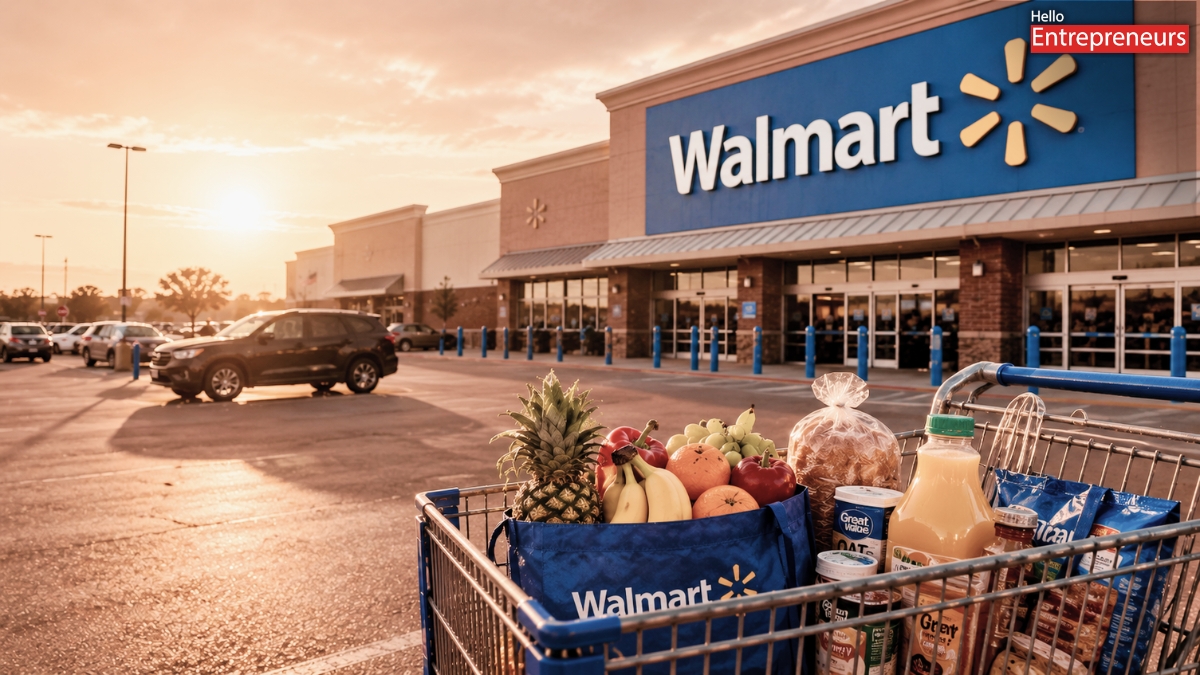
During times of economic anxiety, what consumers do changes in a brutally simple way. They forego their discretionary spending. They abandon premium brands and gravitate toward businesses that offer the promise of dependability, affordability and convenience. Most of the time, that shift leads to only one destination: Walmart.
Last year, as tariffs on global trade rattled the economy, inflation grew more severe and retailers across the United States stuttered, Walmart did something far more extraordinary than simple resistance. It widened the gap between itself and almost every other major retailer.
The contrast is stark. Where Target posted falling sales and Kroger posted flat growth, Walmart continued to grow at a steady al bathe with annual sales growth of 4.7%. Investors responded with equal enthusiasm, propelling the company’s stock to a sharp climb since tariffs reached their latest high in 2025.
The company’s success is not a fluke. It is the very, very direct result of a retail model that is designed to thrive during economic downturns.
Scholars term this consumer shift the “substitution effect.” When prices go up and disposable income shrinks, shoppers deviate from more expensive alternatives and gravitate toward cheaper ones. Walmart has spent a good portion of its life developing a presence that supports this transformation. Especially when the economy stalls, its value proposition becomes even more compelling.
However, there is something far more than price that gives Walmart such power.
The best thing a retailer can have is scale, not just in terms of size, but in the power it provides. An over 100,000 items on display at a Walmart Supercenter give this company immense leverage over the manufacturers and suppliers it does business with. Very few companies in the world have the kind of economic power that Walmart has. Vendor’s know that their products being sold on the Walmart’s shelves means their products are being sold to hundreds of millions of consumers and that fact gives the retailer plenty of negotiating power.
Tariffs on containers and cars raised costs throughout the supply chain. Walmart took advantage and got the suppliers to foot part of the bill instead of shifting it entirely onto the customers. The smaller retailers simply didn’t have that leverage.
This is where the dominance of Walmart becomes more structural than cyclical. The economic downturns do not dent the company’s model; they tend to unwind it.
At the same time, Walmart has quietly become something that many once thought impossible: a technological champion able to compete as a brick-and-mortar retailer in the digital age.
Walmart was investing in e-commerce, curbside pickup and lightning-fast delivery systems many years before the pandemic redefined shopping habits. Those investments are now paying off in large, measurable ways. In fact, digital sales last year reached $150 billion, up 24 percent.
Unlike purely online competitors, Walmart has an advantage based in physical geography. Its 4,600 U.S. stores is not only a retail outlet but also a local fulfilment center. That network enables Walmart to shift product closer to consumers more quickly and efficiently than companies tied to centralized warehouse systems.
The advantage is especially pronounced in grocery retail, where speed and refrigeration are paramount. Fresh food logistics continue to represent one of the toughest operational challenges in commerce. Walmart’s broad store presence gives it a far superior and more agile cold-chain distribution network than much of its competition, including Amazon.
For customers placing grocery orders, distance matters. A closer store stocked with chillers will almost always outperform a fulfillment hub across town trying to deliver chilled goods over long distances.
But perhaps Walmart’s smartest piece of modern grocery strategy lies far beyond the retail shelves.
The grocery business has always been a high-squeeze, low-margin business. Walmart knew long ago that limiting its business to product sales would be a mistake. It began building high-margin businesses around its retail ecosystem , and especially membership and advertising services.
Retail advertising has become one of the fastest-growing segments at the company . Brands are now paying high prices for premium placement in Walmart’s digital properties and marketplace. Subscription and loyalty programs are also growing more profitable. They together totaled about a 27% share of Walmart’s operating profit last year, compared to only a few years back.
The strategy is simple yet powerful: use high-margin businesses to subsidize low prices for core retail.
In practice, advertisers and members are keeping Walmart affordable for millions of shoppers. It’s a model that deepens loyalty and helps protect the company’s market share.
But monopoly power is not without its perils.
Walmart’s good days are here again—and on and on.
Wall Street now expects good results from Walmart quarter after quarter. In fact, analysts now anticipate another stupendous earnings report, with quarterly sales of close to $175 billion. But expectations like those create big problems. The company’s valuation has pushed up to levels that leave no room for concerns. A small slowdown in consumer spending, or less-than-expected growth, could lead to an outsized market reaction.
Walmart’s challenges don’t stop with stocks. The consumers driving growth concern many economists more than Wall Street speculators. They are largely dirtier, lower- and middle-income households burdened by financial strain, and federal assistance to those consumers on grocery programs could decline over time, eroding purchasing power among those customers keeping Walmart’s numbers buoyant.
But for the time being, there is only one Walmart on top of the modern retail world.
Because it’s the company that realized a little earlier than most strips that the retail future was not going to be a battle between physical stores and the internet, but a battle between integrating them. Walmart transformed its vast physical footprint into a logistical asset, leveraged its scale into economic strength, and diversified its revenue stream beyond the basics of retail.
And so while many other legacy retailers are still struggling to navigate structural change, Walmart has shown something even more important: in today’s retail world, you don’t just need to be big. You must turn big into strategy , and strategy into the big.