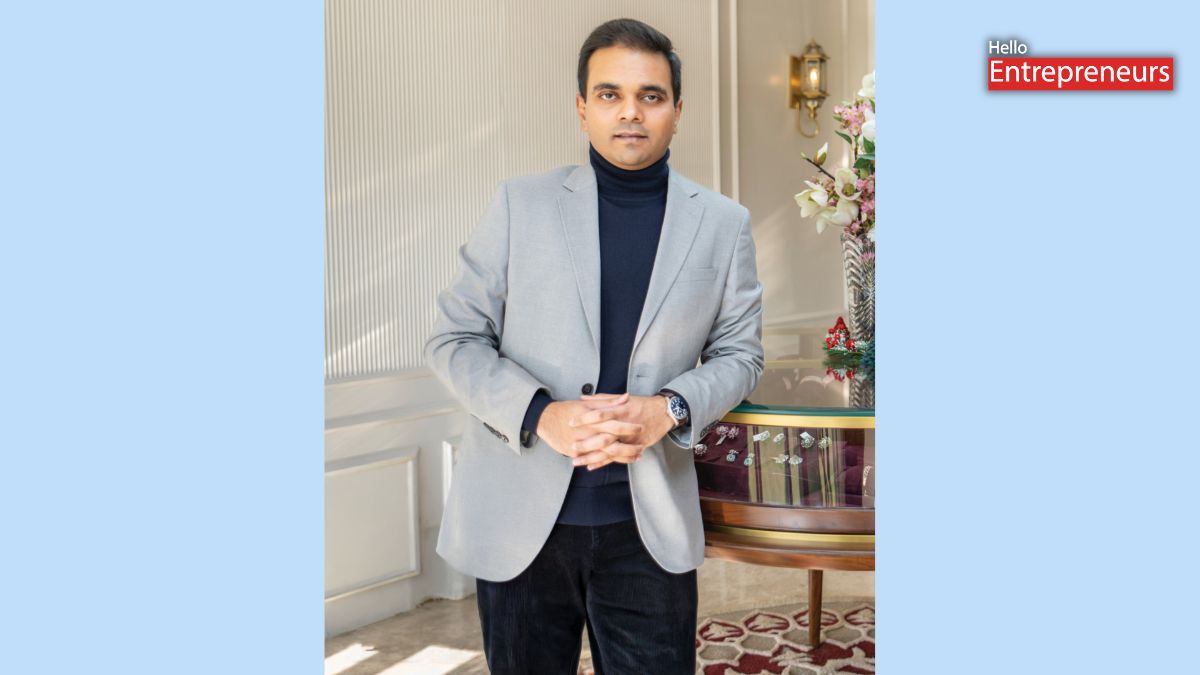








For Samarth Jaiswal, founder of Omara Jewellery, the company’s IPO will be one of the biggest turning points in his goal to scale up the brand. With the funds raised, Jaiswal aims to strengthen its operating structure, expand its retail presence and prepare the business for its next phase.
Samarth has come a long way since he set up the first Omara boutique in Chandigarh in 2015.
“My entry into the jewellery business was driven by a strong belief that there was an opportunity to build a more contemporary and customer-focused diamond jewellery brand. I wanted to create a brand that combined fine craftsmanship and natural diamonds with modern design, while offering clients a more personalised luxury experience,” Jaiswal says.
To date, Samarth has focused on developing Omara’s product portfolio, strengthening its operating processes and building its team for growth. As the company prepares for a public listing, maintaining consistency in quality, service and brand experience while growing responsibly remains a central challenge.
For Jaiswal, the IPO represents the evolution of Omara from an entrepreneurial venture into a more structured and institutionally governed organisation.
From an entrepreneur-driven business to an institution
With the fundraise, Omara is aiming to use the funds to establish a stronger foundation for the company for long term growth rather than simply a means to raise funds.
“As a listed company, there will naturally be a greater emphasis on transparency, corporate governance, financial discipline, systems and accountability. These are areas we are already strengthening as we prepare for the transition,” he says.
Capital allocation and sustainable growth will also receive greater attention. The company intends to balance expansion with operational efficiency and long-term shareholder value. For Omara, the transition to an institutional structure will mean implementing stronger systems and processes to manage inventory, sourcing, quality assurance and working capital management.
This shift will involve strengthening internal processes around quality control, sourcing and financial controls, alongside improvements in inventory planning, procurement discipline and product-level monitoring.
Deploying capital with a focus on sustainable growth
Omara’s capital deployment strategy will focus on strengthening the business across several areas, including working capital, retail expansion, brand building and operational capabilities.
A key priority is working capital, given the importance of inventory availability and product assortment in the jewellery business. Customers expect a range of choices, making inventory management central to both the buying experience and the company’s financial performance.
“A key priority will be strengthening our working capital base, which is important in a jewellery business where inventory availability, product assortment and customer choice are critical,” Jaiswal says.
The company aims to expand its retail presence and strengthen the brand by investing in its existing resources- people, technology, systems and operational capabilities.
However, Jaiswal does not intend to measure expansion solely by the number of stores or the size of the business.
“We do not want to pursue expansion simply for the sake of adding stores or increasing scale. Every investment needs to contribute to building a stronger, more efficient and sustainable business,” he says.
This approach places operational readiness alongside expansion as the company prepares for a larger retail footprint.
Responding to changing diamond jewellery preferences
India’s jewellery market is seeing changes in how consumers discover, evaluate and purchase jewellery. Younger customers, in particular, are looking for contemporary designs, product differentiation and personalised buying experiences.
For Omara, this shift presents an opportunity to build a modern luxury brand around its existing focus on natural diamonds and design-led collections.
“The Indian jewellery market is undergoing a significant transformation. Consumers, particularly younger customers, are increasingly looking for contemporary designs, greater product differentiation and a more personalised buying experience,” Jaiswal says.
The company’s proposition centres on carefully selected natural diamonds and gemstones, craftsmanship, quality and personalised service. Rather than competing primarily on price, Omara wants to create value through product curation, design and customer trust.
“We do not intend to compete purely on price. Our objective is to create value through design, product quality, curation, trust and service. Over time, we believe a strong brand is built through consistency in every interaction with the customer,” he adds.
Consumer awareness of diamond characteristics, pricing and value is also increasing, while the availability of lab-grown diamonds has added another dimension to purchasing decisions.
Omara intends to remain focused on the natural diamond jewellery segment. Jaiswal says the company’s differentiation will come from its overall product and service proposition rather than competition based solely on the price of an individual stone.
At the same time, the company is monitoring changes in consumer preferences, diamond prices and industry dynamics.
Building a connected retail experience
Technology and digital platforms are becoming increasingly important in how customers discover luxury products. For Omara, however, Jaiswal sees digital engagement and physical retail as complementary parts of the customer journey.
Digital platforms provide an opportunity to communicate the brand’s design language, showcase collections and engage with prospective customers. Physical boutiques, meanwhile, offer the personal interaction, trust and experience that remain important when purchasing high-value jewellery.
“For Omara, digital platforms are an important way to communicate our design language, showcase collections and engage with prospective customers. The physical boutique then provides the trust, experience and personal interaction that are particularly important when purchasing high-value jewellery,” he says.
The company sees scope to use technology across the customer journey, from product discovery and enquiries to personalised communication and purchase.
The objective is to build longer-term customer relationships rather than focus only on online sales. This approach is also aligned with the company’s broader emphasis on personalisation and service.
As Omara expands its retail presence, integrating digital engagement with the boutique experience will be part of building a more scalable customer-facing business.
Future roadmap
Jaiswal wants to expand Omara’s retail footprint and strengthen its brand presence, besides building a scalable operating platform for the brand.
Deepening the customer base and becoming a recognised contemporary luxury jewellery brand are also among the company’s stated objectives.
“For me, shareholder value and long-term business building are closely connected. A strong brand, disciplined operations, customer loyalty, and sustainable operational metrics ultimately create a stronger company for all stakeholders,” he says.
The emphasis on sustainable growth is central to how Jaiswal views his responsibilities as a promoter of a company preparing to enter the public markets.
“The focus will be on sustainable growth rather than pursuing growth at any cost. As a promoter, I see my responsibility as building an organisation that can create value consistently over the long term,” he adds.
Beyond the domestic market, Omara is looking at opportunities to expand its product portfolio, strengthen its presence across key Indian markets and evaluate international markets where its brand proposition is relevant.
Disclaimer: Omara Ventures India Limited is proposing an initial public offering of its equity shares and has filed a Red Herring Prospectus (RHP) with the Registrar of Companies. The RHP is available on the website of SEBI at www.sebi.gov.in, as well as on the websites of the book running lead managers and the stock exchanges. Any investment decision should be made solely based on the information contained in the RHP. Potential investors should note that investment in equity shares involves a high degree of risk, and for details, they should refer to the RHP, including the section titled “Risk Factors”.