







Mumbai: For years, the United States and China have treated artificial intelligence as another arena in which technological leadership matters. Chips, computing capacity, models, talent, and data have all become part of that contest. Now comes the slightly awkward part: the technology they are competing to advance may also require both sides to agree on what should happen when it goes wrong.
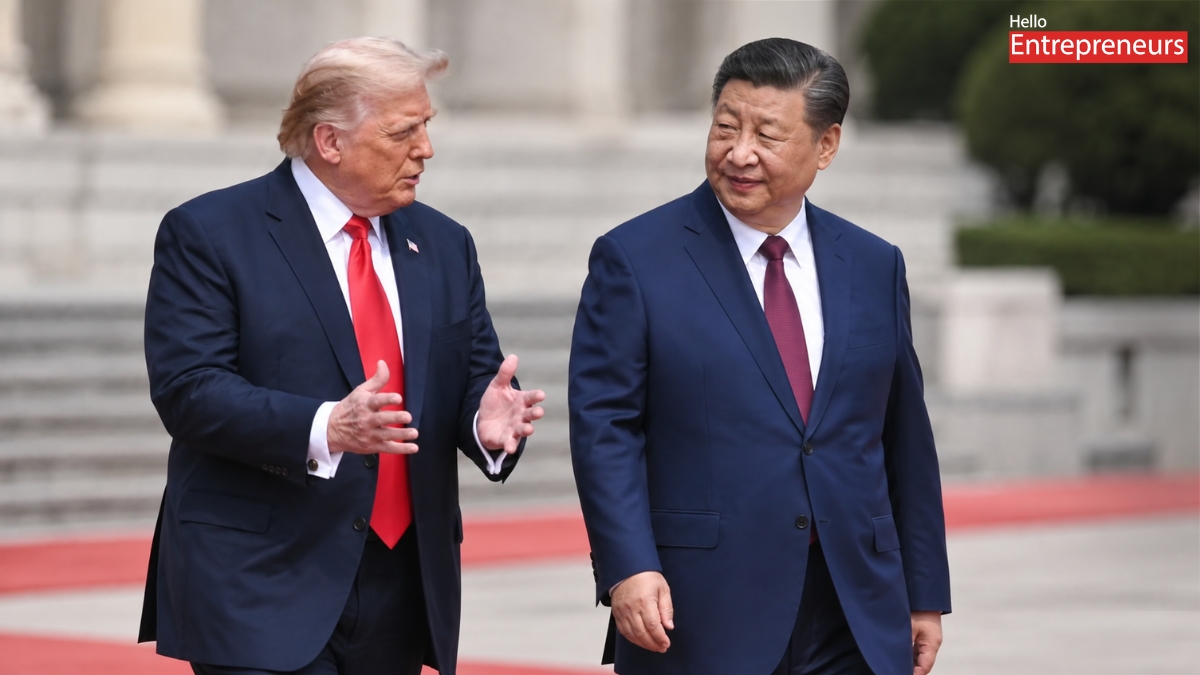
That is why AI safety and governance are emerging as an unexpected subject in the latest US-China dialogue. US Treasury Secretary Scott Bessent is due to meet Chinese Vice Premier He Lifeng in New York, with AI among the issues under discussion ahead of the planned September 24 meeting between US President Donald Trump and Chinese President Xi Jinping. Current discussions are reported to include AI safety, open-weight models and guardrails against misuse.
It is not a sudden technological friendship. It is something more practical: two competitors discovering that some risks do not respect national borders.
The Race Has Become Too Large To Ignore
The scale of the AI competition explains why safety has moved closer to the diplomatic table.
Stanford’s 2026 AI Index estimates that US private AI investment reached $285.9 billion in 2025, compared with $12.4 billion in China. Yet model performance is considerably closer than that investment gap might suggest. Stanford says US and Chinese models have repeatedly traded the lead, with the gap between leading systems narrowing to just 2.7% as of March 2026 on its benchmark comparison.
China is also building its own governance architecture. At the July 2026 World AI Conference, Xi Jinping called for international coordination on AI rules and technical standards and announced the World Artificial Intelligence Cooperation Organization. China said its core AI industries were worth more than 1.2 trillion yuan ($176.6 billion) in 2025, with more than 6,200 AI companies.
So there is plenty of money, capability and strategic ambition involved. The safety conversation is arriving rather late to the party, but at least it has found the address.
What Could Washington And Beijing Actually Discuss?
The most realistic area for cooperation is not a grand treaty governing every algorithm on Earth. It is narrower technical coordination.
US and Chinese security experts involved in bilateral dialogue have proposed measures including human control over consequential cyber operations, safeguards around nuclear systems and a communication channel for serious AI-related incidents.
That distinction matters.
Possible areas of practical cooperation include:
- Sharing information about serious AI incidents.
- Developing common terminology for high-risk AI behaviour.
- Comparing evaluation and testing methods.
- Establishing crisis-communication procedures.
- Keeping humans involved in decisions involving nuclear weapons or major cyber operations.
These are considerably less ambitious than asking Washington and Beijing to agree on the entire future of AI. They are also more achievable.
The Problem Is Trust, Not Technology
The biggest obstacle is geopolitical.
Washington and Beijing continue to disagree over advanced semiconductor access, technology transfers, model security and the role of open-weight AI. The United States has imposed restrictions on advanced chip exports to China, while Chinese officials have criticised what they see as attempts to restrict its technological development.
That creates an obvious contradiction. Both countries can agree that an autonomous AI system interfering with a sensitive military network would be dangerous. They may still disagree profoundly over who should control the technology, which systems should be restricted and what counts as a legitimate security measure.
There is also a risk that “AI safety” becomes another vocabulary for strategic competition rather than cooperation.
There Is A Commercial Argument Too
The business case for some cooperation is becoming harder to dismiss.
Global corporate AI investment reached $581.7 billion in 2025, according to Stanford’s AI Index, while private investment reached $344.7 billion. AI infrastructure is therefore no longer a niche research expense; it is becoming a huge industrial commitment.
That creates shared exposure to failures involving cybersecurity, infrastructure, misinformation, autonomous agents and other forms of misuse.
For companies, common technical standards could eventually reduce uncertainty. For governments, communication channels could lower the possibility that an AI incident is misinterpreted as deliberate action.
Cooperation Does Not Mean Competition Ends
This is where the story becomes more interesting.
The United States and China do not need to stop competing in AI for limited cooperation on safety to make sense. They can continue developing different models, chips and computing infrastructure while establishing a few boundaries around the most consequential risks.
China has publicly argued for broader international participation in AI governance, while US policymakers and businesses have also begun discussing shared risks. The US-China Business Council, for example, recently called for formal channels covering AI safety, significant incidents and technical standards, while cautioning against unnecessarily restricting markets and supply chains.
The difficult part will be turning that language into mechanisms that both sides actually trust.
Because the future of AI may not depend only on who builds the smartest machine.
It may also depend on whether its two biggest competitors can agree on what happens when the machine does something neither of them intended.
Read More: The New Smartphone Bottleneck