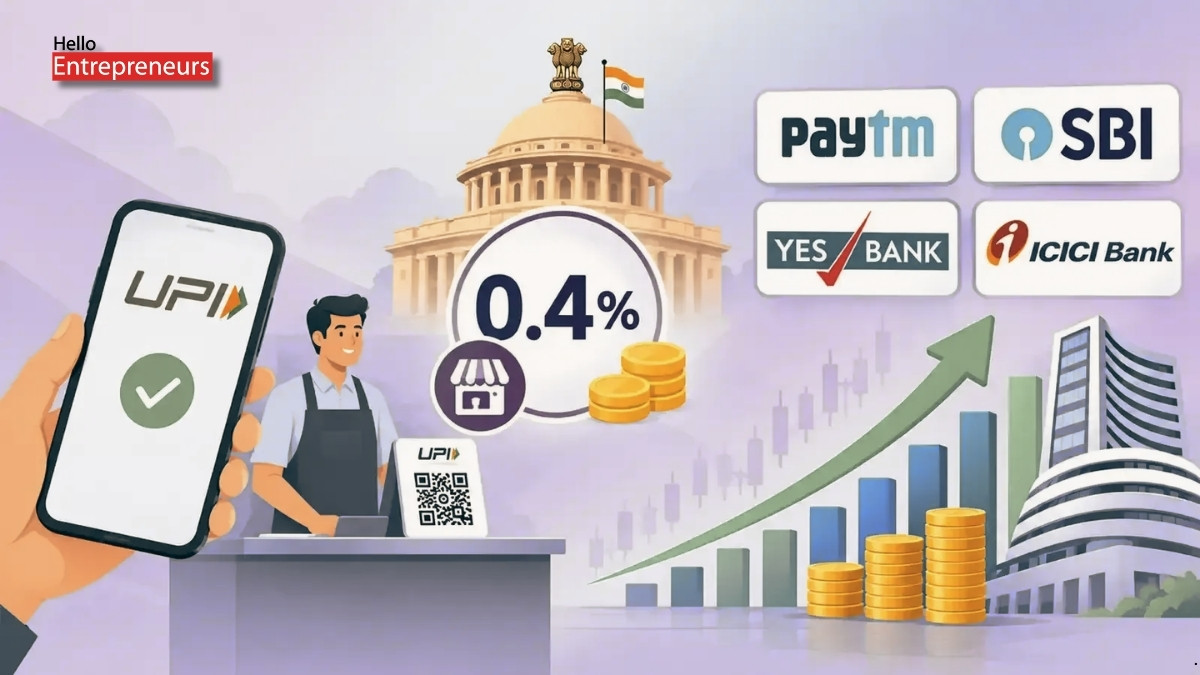






New Delhi: Shares of payment and banking companies, including Paytm, YES Bank, State Bank of India (SBI), Bank of Baroda and One Mobikwik, traded higher on Wednesday after the National Payments Corporation of India (NPCI) introduced a new Merchant Discount Rate (MDR) framework for select UPI merchant transactions above ₹2,000.
The new framework will come into effect from October 15. Under the revised structure, a 0.4% MDR will apply to eligible person-to-merchant (P2M) UPI transactions above ₹2,000, with the charge capped at ₹300 for transactions of ₹75,000 and above.
The Finance Ministry clarified that the MDR will be charged within the merchant payment ecosystem and will not be directly imposed on customers. Person-to-person (P2P) UPI transactions will continue to remain free, irrespective of the transaction amount, while merchant payments up to ₹2,000 will also remain outside the new charge.
Individuals will continue to have unlimited free UPI usage without monthly quotas, volume restrictions or tiered caps on free transactions.
How payment and bank stocks moved
At 9:28 am, shares of One 97 Communications, the parent company of Paytm, were trading 1.24% higher at ₹1,751.40 on the NSE. The stock touched a 52-week high of ₹1,855.50 during the session, representing a 7.25% rise from its previous close of ₹1,730.
Among banking stocks, YES Bank shares gained 3.34% to ₹23.84. SBI shares rose more than 1% to ₹979, while Bank of Baroda was up 0.24% at ₹233.25.
The new MDR framework has drawn attention because the fee will be shared among participants in the payment ecosystem, including banks and UPI application providers.
What changes for merchants and users?
The standard MDR of 0.4% will apply only to eligible P2M transactions above ₹2,000. Essential and thin-margin sectors, including railways, telecom, insurance, fuel and agricultural inputs, will instead attract a flat ₹5 MDR above the threshold.
Government utility bill payments for electricity, water and piped gas, along with educational fee payments such as school and university tuition, will also receive flat-fee treatment for transactions above ₹2,000.
Payments involving mutual funds, securities, stockbrokers and dealers will attract a lower MDR of 0.02%, capped at ₹300.
The Finance Ministry has said more than 95% of P2M transactions are below ₹2,000 and will therefore remain outside the standard MDR framework. P2P payments, which account for around 37% of UPI transaction volume and 70% of transaction value, will continue to carry no charge.
Analysts estimate a sizeable revenue opportunity
The change has also prompted fresh estimates about the potential revenue impact on banks and payment companies.
Citi estimates that the new framework could create an incremental annual ecosystem revenue pool of ₹16,000-17,000 crore. It estimates that around 60% could accrue to banks, 25% to UPI application providers and 15% to non-bank payment aggregators.
Goldman Sachs estimates that around 50% of overall UPI transaction value could fall into the 40-basis-point MDR category, resulting in a potential industry revenue pool of around ₹20,600 crore. It has estimated a potential incremental EBITDA of ₹1,400 crore for Paytm in FY28 under its high-end scenario.
JPMorgan estimates the maximum revenue pool at around ₹17,000 crore. Of this, it estimates around ₹11,700 crore could accrue to banks, ₹1,700 crore to payer platform service providers and ₹3,400 crore to third-party application providers.
The actual benefit for individual companies will depend on their transaction mix, market share and position within the UPI payment ecosystem after the new framework takes effect.
With PTI inputs
Disclaimer: This article is for informational purposes only and should not be considered investment advice. Securities mentioned are illustrative and not recommendations. Please consult a qualified financial adviser before making investment decisions.