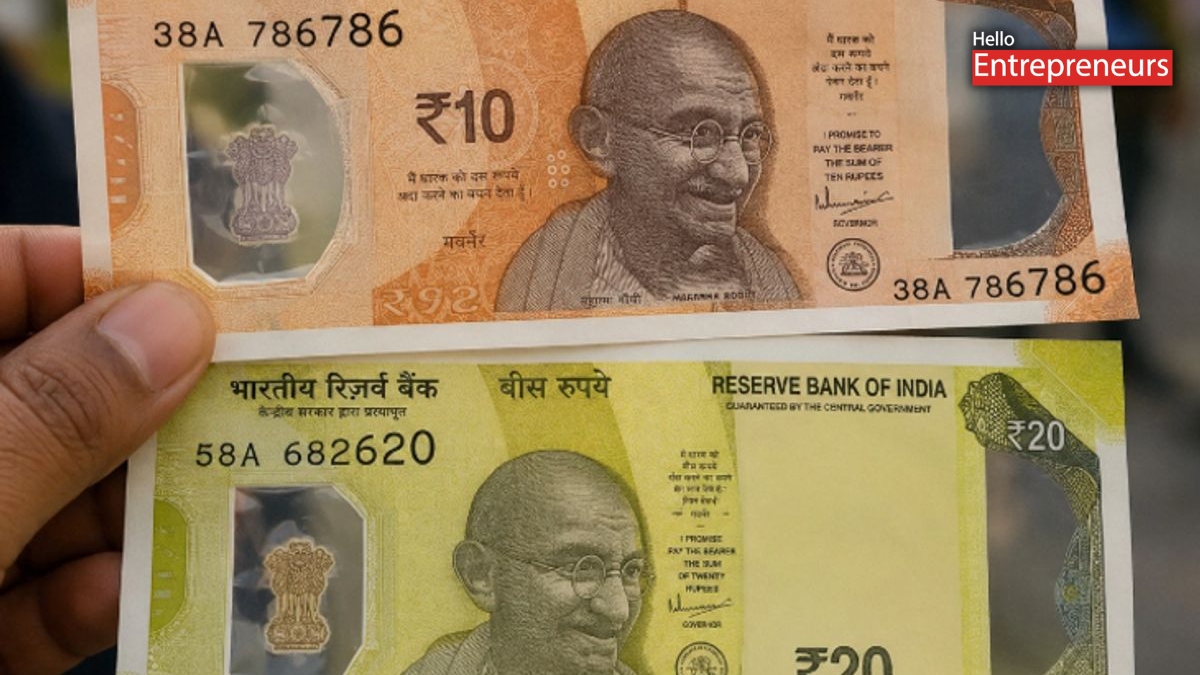








New Delhi: India is on its way to make an important step towards the history of its currency. Government has granted permission to the Reserve Bank of India (RBI) to conduct trials on one billion ₹10 and ₹20 polymer banknotes. In the event of success from the trials, polymer notes would be a regular feature of the Indian currency system.
The move assumes importance as normally, Indian currency is manufactured with the paper-based material. Polymer notes are notes made of a special plastic material which is designed to be stronger, long-lasting and include a combination of features which make the notes more secure.
A major shift from traditional paper notes
The most significant difference will be in the note stock used for making the notes. Polymer notes, as opposed to paper ones, are water, dirt and wear resistant. Polymer notes are also more robust than paper notes.
This may be helpful in handling ₹10 and ₹20 notes. The denominations mentioned above are widely used in the day-to-day business and are dealt with many times. This means they are more likely to be less in good condition and can be ruined or used up sooner than notes of greater value.
A longer note would make it less necessary to have to exchange damaged notes and money. This can also boost the effectiveness of the cash management system in the country.
Better security could be another advantage
Modern security features could include embedding difficult-to-replicate patterns and/or characteristics into polymer banknotes.
Features such as transparent areas, special printing techniques and other security elements can be incorporated into polymer currency. This may assist the RBI to enhance security at the counterfeiting of notes.
But the features and security technologies India has designed for its polymer notes of ₹10 and ₹20 have not yet been revealed. The field trial will enable authorities to observe performance of the notes in real life situations.
India has tried polymer notes before
The plan of polymer money is not all alone in the Indian sub-continent. The RBI had earlier tried the polymer notes of ₹10 currency notes in five cities in 2013. But the era of the polymer currency was yet to begin in the Indian currency system. Approval has been given on this much bigger scale.
The government has allowed for the field trial of two billion notes in total – one billion ₹10 notes and one billion ₹20 notes. Results from these trials will determine whether regular issuance will be in effect.
Paper notes will not disappear immediately
The announcement has nothing to do with the switch to all paper money to plastic notes in India.
The polymer notes will be issued at first hand in tandem with the old notes made out of paper. The government has also assured people there is no plans to ditch the paper currency altogether and replace it with polymer currency.
This implies that traditional ₹10 and ₹20 denomination banknotes will be in circulation and the RBI will continue to monitor the performance of the newer polymer banknotes.
Could this be a new chapter for the rupee?
In case the trials are favorable, polymer notes could be an important paradigm in the evolution of the Indian currency.
India’s journey of currency has already undergone multiple stages, evolution from paper notes to suggested improvements in design and strengthened security features. The next big change could be in the form of polymer banknotes.
For regular folks, the change will be a ₹10 or ₹20 note that feels different in their fingers. However, if it comes to pass in the country’s currency system it could be a longer-lasting note, more secure note and may be more efficient cash management.
The government’s recent clearance is thus more than just a flow of paper currencies, with two denominations. It may herald new age in banknotes for the Indian rupee in terms of durability and containing secure features in addition to the value printed on the banknote!