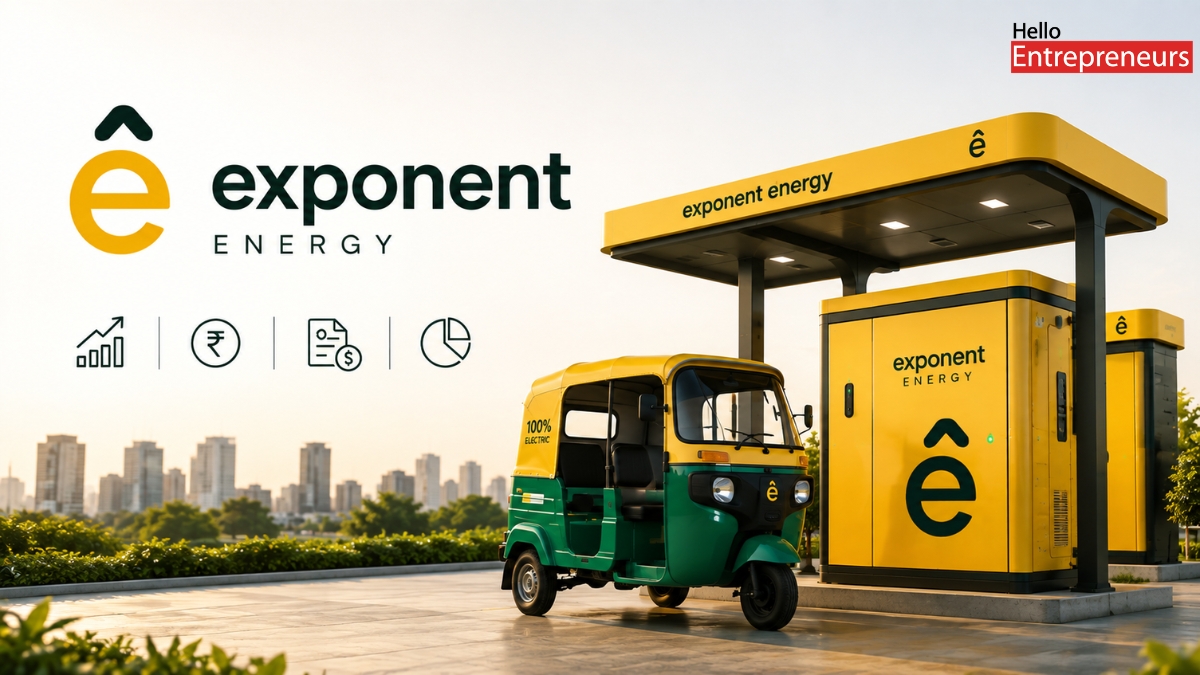








New Delhi: Exponent Energy isn’t your everyday EV charging startup. While most companies in Bengaluru are scrambling to dominate bike battery swapping, Exponent’s founders—Arun Vinayak and Sanjay Byalal Jagannath—decided to go after something tougher: a full-stack, rapid-charging solution for commercial electric vehicles. They built their own battery packs, chargers, and even connectors, all designed to juice up a fleet vehicle in just 15 minutes. That sounds bold, and six years later, they’ve turned heads—not just with their tech, but with a valuation that’s now more than ₹1,300 crore.
The Origin Story
Exponent started in 2020, but didn’t rush things. Their first funding round landed about a year post-incorporation, and those early days were pure deep-tech—slow money, patient backers, and lots of engineering before any commercial launch. Unlike Ola Electric (which gobbled up huge investment before delivering a single scooter), Exponent kept quiet until their charging stations (“e^pump”) and batteries (“e^pack”) were actually in the hands of fleet operators.
Funding Journey—Step by Step
Exponent’s funding history is steady, not flashy:
- 2021–22 (Seed rounds): YourNest and other early investors came on board, setting up the basics.
- August 2022 (Series A): Eight Roads Ventures and crew joined, and the company started scaling up its charging network in Bengaluru.
- December 2023 (Series B): They raised $26.4 million, jumping to a ₹797 crore valuation. Lightspeed India and 3one4 Capital were in the mix.
- March–June 2026 (Series B extension): After a bit of a lull, Exponent closed another $20–21 million, with 360 ONE Asset and TDK Ventures as co-leads, and Hitachi Ventures investing in Indian energy for the first time. All the old backers stuck around.
In total, by mid-2026, Exponent has pulled in about $65–68 million (depending who’s counting and their currency math). That’s not massive compared to India’s bigger EV startups, but it fits Exponent’s style: build hardware, keep spending efficient, and grow carefully.
Valuation and Cap Table
After their June 2026 round, Exponent sits at roughly ₹1,300 crore in value (about $136 million)—a 60% jump from where they were at the end of 2023. Sure, it’s less than what Ather Energy is worth, but it’s real progress for a company that’s focused on infrastructure, not vehicles.
Ownership is about what you’d expect from an Indian Series B startup: institutional investors hold around 69%, the founders keep about 16%, and employees get nearly 10% through an ESOP pool—a healthy chunk for luring engineers away from the big names.
Revenue: Quick Growth, Modest Base
Now, the numbers. Revenue more than doubled from ₹20.8 crore in FY24 to ₹44.1 crore in FY25. That’s a solid 112% growth rate—a stat any VC likes to see. The absolute revenue isn’t huge, especially compared to Battery Smart’s swap networks, but Exponent’s trajectory is what gets attention.
For perspective: Lohum (battery recycling) is reportedly lining up a pre-IPO round worth ₹1,000 crore. That shows investors believe there’s real scale in India’s battery infrastructure market, not just in making vehicles. Exponent’s growth has them joining that conversation, just a bit earlier on the curve.
The New Lending Play
Early 2026 saw Exponent launching “Exponent ONE”—a new lending arm, backed by $2 million in pre-seed cash. The problem they’re tackling? Banks and NBFCs don’t really trust EV batteries as loan collateral, given doubts about their value over time. But Exponent’s own telemetry data (years of real-world battery usage) gives them an edge. So now, besides selling charging gear, Exponent can actually underwrite loans on EVs that use their batteries—a smart extension.
How’s Exponent Different from Rivals?
There’s plenty of fast-charging and battery swap action in India, but Exponent isn’t playing the same game as Battery Smart, Lohum, Statiq, or Chargeup. Instead of building chargers for every possible vehicle, Exponent focuses on commercial EVs—like three-wheelers and small trucks—which need that rapid charge to keep fleets running. One-size-fits-all chargers can’t deliver that.
Wrap-Up
Exponent Energy took its time perfecting tech and earned investor trust by proving its products with real fleets—not just hype and fundraising. With $65–68 million raised, a ₹1,300 crore valuation, revenue growing at serious speed, and a new lending branch to boot, Exponent feels less like a typical EV startup and more like a company betting that infrastructure for commercial fleets will matter way before fast-charging becomes a thing for consumer cars.