








We may faintly remember learning about the green revolution, which explained how India became self-sufficient in foodgrain production over the years. For India, that was a crucial reform back then, as it helped us become self-sufficient in food grains, a challenge that we had to face considering our growing population.
Though it remained a success, it depended on the use of fertilizers and pesticides to protect and boost yields. Due to growing demand, India has had to rely on imports to meet it, and that has continued to this day.
Why do we have to import fertilizers?
Surging demand has consistently forced India to import fertilizers, with domestic production remaining inadequate. Besides, the raw materials needed for fertilizer production are not available locally, necessitating imports.
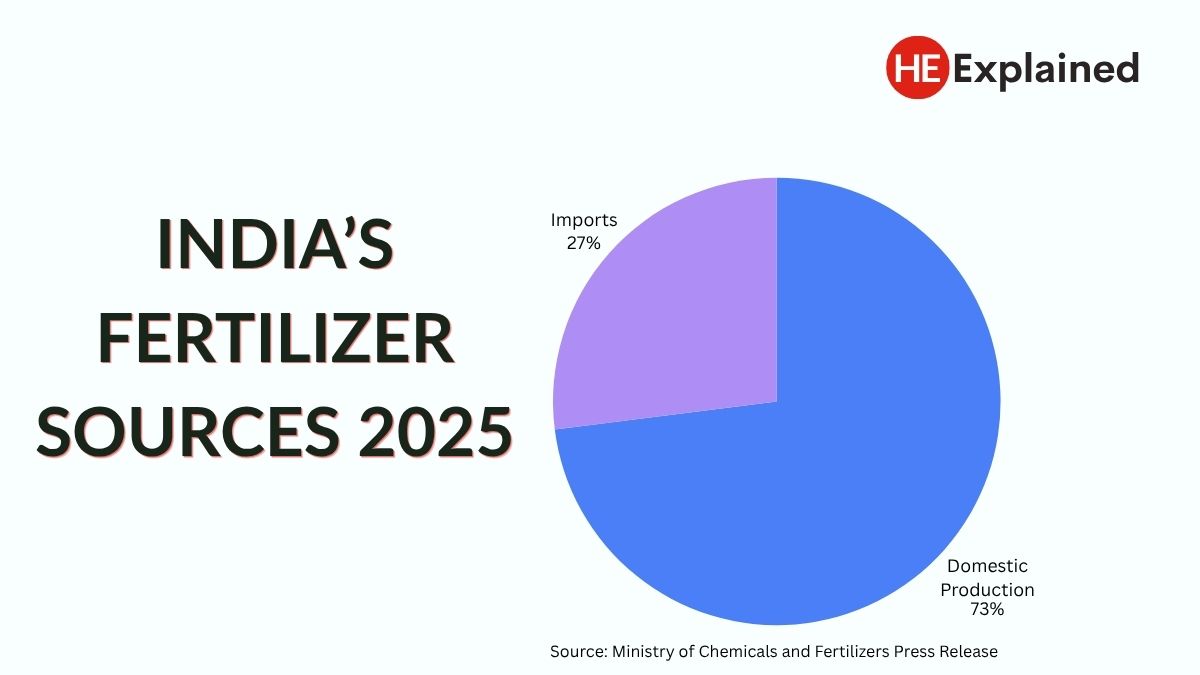
Today, even though we produce about 70% of our fertilizers domestically, we have to depend on imports from China, Russia, Morocco, and Saudi Arabia to fill the gap. Generally, farmers require three major fertilizers: urea, DAP, and potash, along with their derivatives.
Amongst them, India produces urea domestically, but supplies remain inadequate for demand. Production relied on imported Liquefied Natural Gas (LNG) and, to some extent, ammonia for production.
For DAP, the fertilizer required to boost phosphorus content in the soil, India requires to import almost 60% of its requirement. Most of it comes from China, Saudi Arabia, Russia and Morocco, with domestic production too relying on imported raw materials as well.
With Potash, India is completely import dependent, as India cannot produce potash domestically, importing the same from Canada, Russia and Jordan.
Overall, India remains the world’s largest fertilizer importer, spending upwards of $10 billion on importing around 16-20 million tonnes of fertilizers each year. India has consistently ranked amongst the top 5 fertilizer importers worldwide.
The biggest threat to food security: Supply chain disruptions
India’s capability to feed its population rests on a consistent, continuous and reliable supply of fertilizers from the global markets. Though we may take this for granted for long, the fact is that these vulnerabilities can show up when you least expect it.
With the West Asia hostilities cutting off energy and fertilizer supplies from the Middle East, India has had to spend through its nose for fertilizers from alternative sources. Besides this, burgeoning industrial demand can also affect the supply of fertilizer for India, as seen with the case of DAP, where China has diverted supplies for domestic manufacturing purposes.
Two years ago, China supplied 22 lakh tonnes of DAP to India, with none this year. The fertilizer, crucial for the maize, rice and wheat crops, has been used judiciously by farmers for years, and they are now concerned about how the yields will turn out if supplies don’t come in time for the sowing season.
The subsidy buffer
Most of us don’t realise the challenges faced by the government in this regard, as prices could remain stable, at least for the time being. But the government has its own reasons to be concerned, as it has to spend more for subsidizing fertilizers, which is already up to 1% of India’s GDP. For the fiscal year 2025-26, this has meant a subsidy of Rs.1.68 lakh crore (about $20 billion) which could balloon up to Rs.3 lakh crore if the supply chain disruptions continue.
The lack of options
The government already subsidizes anywhere between 50% and 90% of the fertilizer costs, based on several factors, keeping prices artificially low while eating up the inflation.
For the government, this expense remains a necessity, as fertilizer demand keeps increasing with domestic production struggling to meet demand. Though the Aatmanirbhar Bharat and Make In India initiatives have been fairly successful in defence production and electronics, the government cannot encourage the same for fertlizer production, as India has no reserves of the required potash, phosphate or natural gas in enough quantities for domestic production.
Though the government can work towards substituting energy imports with EVs, there remains no large scale alternative to fertlizer use, forcing the government to quietly continue to bear the global price rises to keep food costs low.