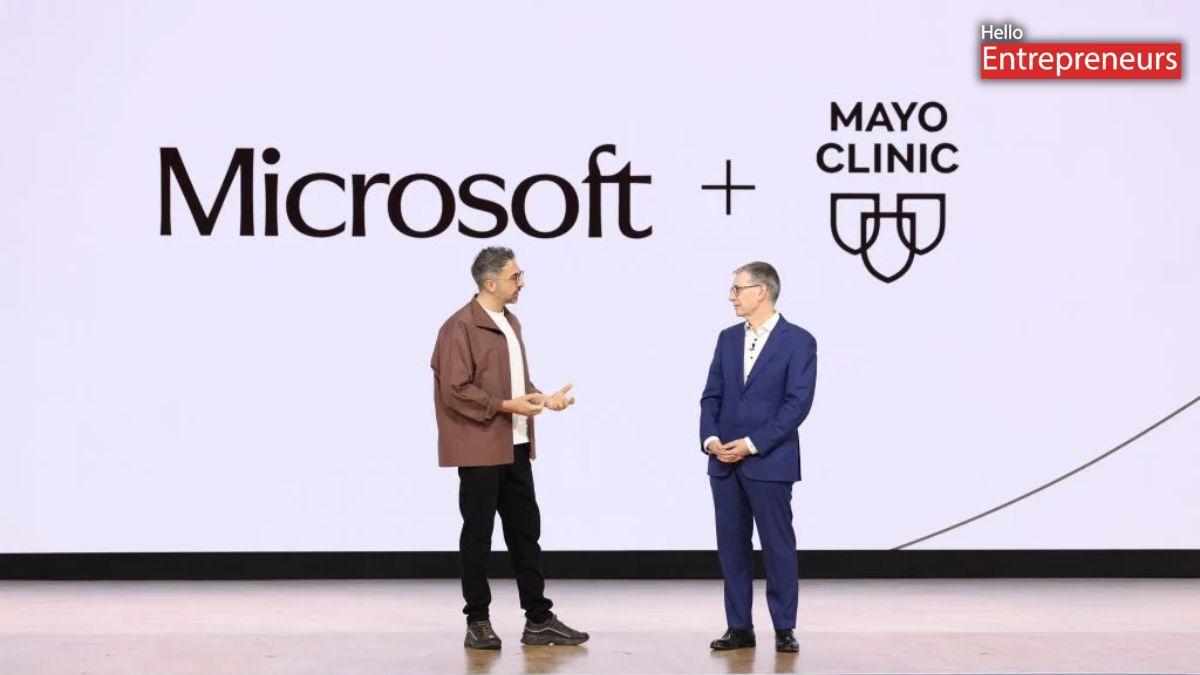








New Delhi: Microsoft has officially announced its recent partnership with Mayo Clinic. Along with the partnership, they have also announced seven latest in-house MAI models across reasoning, coding, image generation, voice, and transcription. It includes MAI-Thinking-1, MAI-Code-1-Flash, MAI-Image-2.5, MAI-Image-2.5-Flash, MAI Transcribe-1.5, MAI-Voice-2, and MAI-Voice-2-Flash. The models form a multimodal family that is especially designed to work across real-world tasks and integrate into products used by individuals, developers, and organizations.
This recent announcement also unveils Microsoft Frontier Tuning, an approach for adapting models to organizations’ specific workflows. For developers and education offers aimed at AI skills, the unveil brings the latest model capabilities into coding, software engineering, voice, transcription, and enterprise workflow training. MAI-Code-1-Flash has been built for GitHub Copilot, Visual Studio Code, and Microsoft’s wider stack. Microsoft AI is also working with Mayo Clinic to co-create a frontier AI model for healthcare, using Mayo Clinic’s clinical expertise, de-identified clinical data, and longitudinal insights, along with Microsoft’s foundational AI capabilities.
MAI-Thinking-1 is Microsoft AI’s flagship reasoning model. The model was trained from the ground up on the clean data, without any distillation from third-party models, and matches leading models on key software engineering benchmarks. Microsoft AI CEO, Mustafa Suleyman, posted on LinkedIn and said that MAI-Thinking-1 is a 35B active parameter MoE with a 256K context window and had reached 97% on AIME 2025 and 53% on SWE Bench Pro.
MAI-Code-1-Flash is an interface-efficient agentic coding model designed for GitHub Copilot, Visual Studio Code, and the Microsoft Stack. Suleyman stated that the model has 5 billion parameters and is especially tuned for VS Code and GitHub Copilot CLI. MAI-Image-2.5 and MAI-Image-2.5 Flash support text-to-image generation and image editing. MAI Transcribe-1.5 is positioned for transcription across 43 languages, while MAI-Voice-2 supports speech generation across 15 languages and can adapt to voice from a short sample with safeguards against misuse. MAI-Voice-2-Flash is listed as coming soon, with the Microsoft AI describing it as a low-cost and more efficient package.