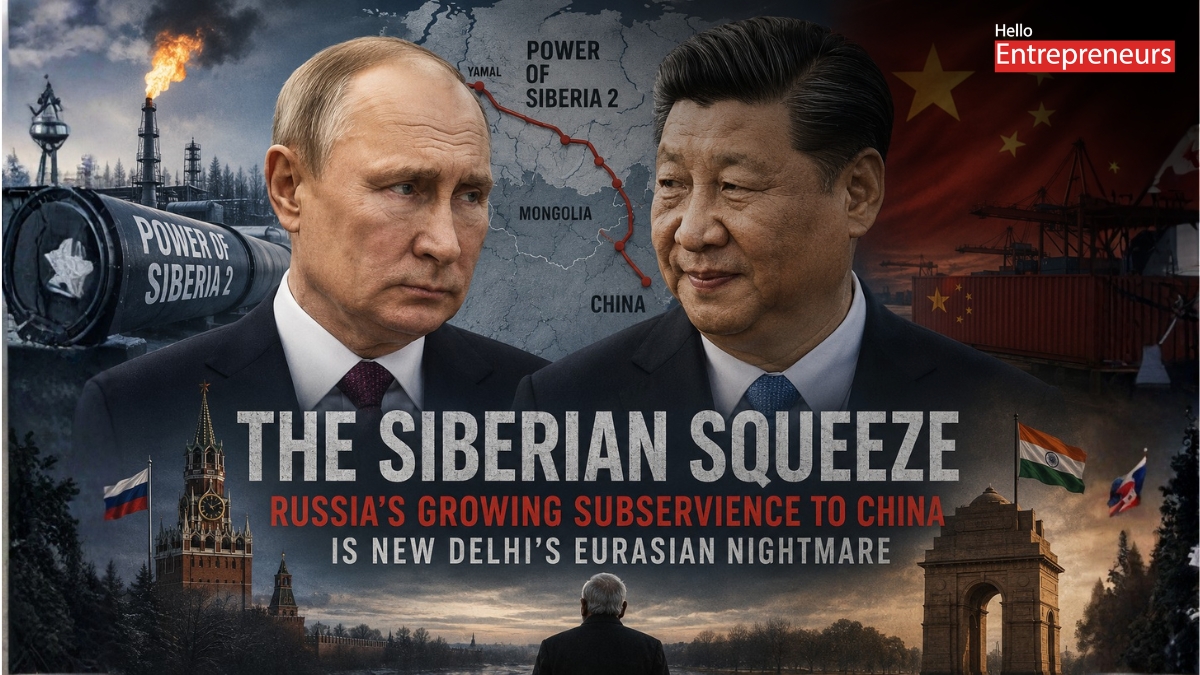








For many years, India’s Eurasian grand strategy depended on one key assumption: that Russia, even in all its idiosyncratic guile and barbarity, was ultimately autonomous. That Russia was not just a defence partner but a continental counterbalance to preemption by China.
That assumption is starting to crack.
Sanctions imposed by Western powers serve to isolate Russia’s economy, but they also are tightening the Kremlin’s financial flexibility. This is turning Moscow’s pivot to Beijing from tactical diplomacy to structural dependency, for better or worse. The consequences for New Delhi are staggering. A Russia bound to Beijing economically erodes New Delhi’s strategic space of manoeuvre, but it leaves Beijing with coveted access to energy, expanded continental geostrategic influence, and a steadied geopolitical footing.
The most recent indicator, President Vladimir Putin’s new push to finally complete the long-delayed Power of Siberia 2 gas pipeline project with China, confirms this trend. This isn’t simply a partnership as much as a plea for favourable terms from Moscow.
The Illusion of Equality Inside a Sino-Russian Axis
Underground, Moscow and Beijing show no signs of lessening their rhetoric of a partnership of equals who resist Western dominance. In reality, almost all the power in the alliance has snowballed in favour of China.
The numbers speak for themselves. The Chinese economy is now many times larger than the Russian one—China’s GDP is several times Russia’s—which gives Beijing considerably more leverage to negotiate with Moscow on trade, finance, technology, and energy markets. The Ukraine war and the subsequent sanctions regime meant Russia was cut off from many Western markets, parts of the Western banking system, and advanced industrial technology, further tipping the scale.
The result is an uneven exchange.
Russia is filling China’s orders for raw material supplies – natural gas, oil, seafood, timber, agricultural products, honey, and crabs, to name the curses, while China supplies many of the technologies that Moscow needs to support its civilian economy and industrial base. Chinese drones, robotics, machine tools, and a range of electronics and component-level supplies have helped mitigate some effects of sanctions on Russia’s production networks.
The dependency is growing – not only economically, but also politically.
It came up to its heel just a few days before Putin’s arrival in the city of Irkutsk in Siberia, where Russian citizens publicly appealed to regional authorities and, in some cases, to Chinese companies over cross-border projects after years of local grievances with federal and regional governments. When Russian citizens or local bodies seek foreign investment or cooperation to address local infrastructure gaps, it can reflect shifting regional economic dynamics and increased Chinese presence; it does not, however, indicate formal political subordination to Beijing.
This is a center-of-gravity shift in parts of the region away from exclusive Moscow-centric development. The Kremlin may still control nuclear forces and wield military power, but economically and structurally in certain sectors and regions, Russia is becoming more integrated with China and thus playing an increasingly junior role in aspects of an Asian-led Eurasian order.
Power of Siberia 2: The Pipeline That Is Reshaping Eurasia’s New Power Structure
At the heart of this new Eurasian power structure is Moscow’s flagship pipeline project to carry Russian gas exports to China, Power of Siberia 2 (PoS-2).
The new pipeline has been proposed to carry up to about 50 billion cubic meters (bcm) a year from Russia’s Yamal Peninsula to northern China via Mongolia. For the Kremlin, the project is important. Europe was once Russia’s largest pipeline gas market, but flows and contracts were significantly disrupted after Russia’s 2022 invasion of Ukraine, and Moscow needs substitute revenue that PoS-2 is designed to provide.
But the deal has been delayed after years of negotiation because Beijing has the upper hand in price and contractual terms.
Russia has sought terms that would reflect higher prices closer to previous long-term contracts; China, by contrast, has pushed for prices and terms more favourable to buyers, arguing for parity with other long-term or domestically sourced supplies. China recognizes that its large market and alternative suppliers give it leverage.
There has not been another buyer with the capacity and long-term need to absorb such pipeline volumes on a comparable scale, which increases Beijing’s negotiating power. The urgency on Moscow’s side to replace lost European markets is higher than for any single buyer, giving China additional leverage.
“Why the Middle East Crisis Suddenly Matters”
Moscow is now trying to use disruptions in global energy flows as leverage to push the deal with China forward.
Escalating regional conflicts and disruptions near the Strait of Hormuz have highlighted fragility in the global seaborne Liquefied Natural Gas (LNG) supply chain. With Middle Eastern producers accounting for a significant share of China’s LNG imports, the Kremlin has argued that overland energy corridors from Siberia would give Beijing a strategic alternative to seaborne routes.
This addresses a long-standing Chinese concern about at-sea vulnerability.
Chinese strategists have long worried that chokepoints like the Strait of Hormuz and the Straits of Malacca could threaten critical energy imports in a major naval crisis. Overland pipelines reduce that risk.
Yet despite Putin’s statements that “practically all key issues” regarding the project have been settled, Beijing has insisted on detailed commercial and financing terms, and negotiations have continued. President Xi Jinping wants favourable costs while maintaining leverage over Moscow through long-term commercial ties.
It increasingly feels more like a time-honored commercial negotiation than an equal-state alliance.
Why India Must Be Worried
It’s not just Russia-China trade that’s at issue for New Delhi.
A Eurasian policy for India historically relied on diversifying ties with several power centers. An independent, strategically autonomous Russia provided New Delhi a partner that limited China’s dominance in parts of Eurasia—Central Asia, defense manufacturing collaboration, Arctic access, and certain continental energy linkages.
The balance is already under strain.
The Collapse of a Eurasian Balancer
If Russia comes to depend heavily on Chinese financing, industrial supply chains, and energy markets, its ability to act independently during future India-China crises could be weakened.
In a future skirmish along the Line of Actual Control (LAC), India cannot automatically assume that Russia would remain strategically autonomous. Even if Moscow avoids openly siding with Beijing, deep economic ties could constrain its political and defense options.
The loss of one of India’s most useful geopolitical counterweights would narrow New Delhi’s strategic choices.
China’s “Malacca Dilemma” is Slowly Vanishing
The Power of Siberia 2 project would bolster China’s long-term strategic resilience.
Beijing’s maritime energy-import dependency created vulnerabilities known as the “Malacca Dilemma.” Much of China’s oil and gas imports transit through narrow maritime chokepoints that could be disrupted in a crisis.
If PoS-2 is completed and operational, Russia’s share of China’s pipeline gas imports could rise substantially. Combined with existing pipelines from Central Asia and domestic output, this would give China a more resilient overland energy architecture less exposed to naval pressure. It would not eliminate maritime vulnerabilities—China remains dependent on seaborne oil and LNG for large portions of its energy—but it would materially reduce some risks.
An energy-secure China is not only economically stronger but also strategically harder to pressure.
For India, this changes continental deterrence calculations and supply-chain resilience.
India’s Own Infrastructure Gap is Starting to Surface
The crisis has also revealed India’s relative vulnerability in energy logistics.
While China has spent decades building overland pipelines, storage, and strategic reserves, India remains heavily dependent on maritime LNG imports. A large share of India’s oil and gas imports transit through the Strait of Hormuz.
The current instability has prompted New Delhi to accelerate plans such as a proposed subsea gas pipeline from the Gulf region to western India and further diversification of suppliers and routes. The referenced ₹40,000 crore (roughly $4.8 billion) figure corresponds to publicized estimates for large energy infrastructure projects, but cost and financing details remain subject to change.
The contrast is significant.
China has been systematically expanding overland options for years. India is moving more quickly now to reduce maritime vulnerabilities.
The Bottom Line
Putin and Xi sipping tea in Beijing may conjure images of stability, partnership, and Eurasian solidarity. But beneath the surface lies a far more consequential transformation.
Russia is no longer simply cooperating with China. It is increasingly tying parts of its economic activity to Beijing’s industrial and financial ecosystem. That shift changes the Eurasian strategic balance.
For India, the challenge is no longer merely one of managing a rising China. It now is one of coping with a weakened Russia that may be less able or willing to act as an independent counterpart to China in Asia.
The multipolar Eurasia New Delhi sought is at risk of becoming a more narrowed and unequal strategic order with growing Chinese leverage.
India’s response will require more than fond reminders of old partnerships. It will need faster energy diversification, deeper industrial self-sufficiency, strengthened maritime security, and a foreign policy responsive to a continent in which Moscow is increasingly economically aligned with Beijing.