



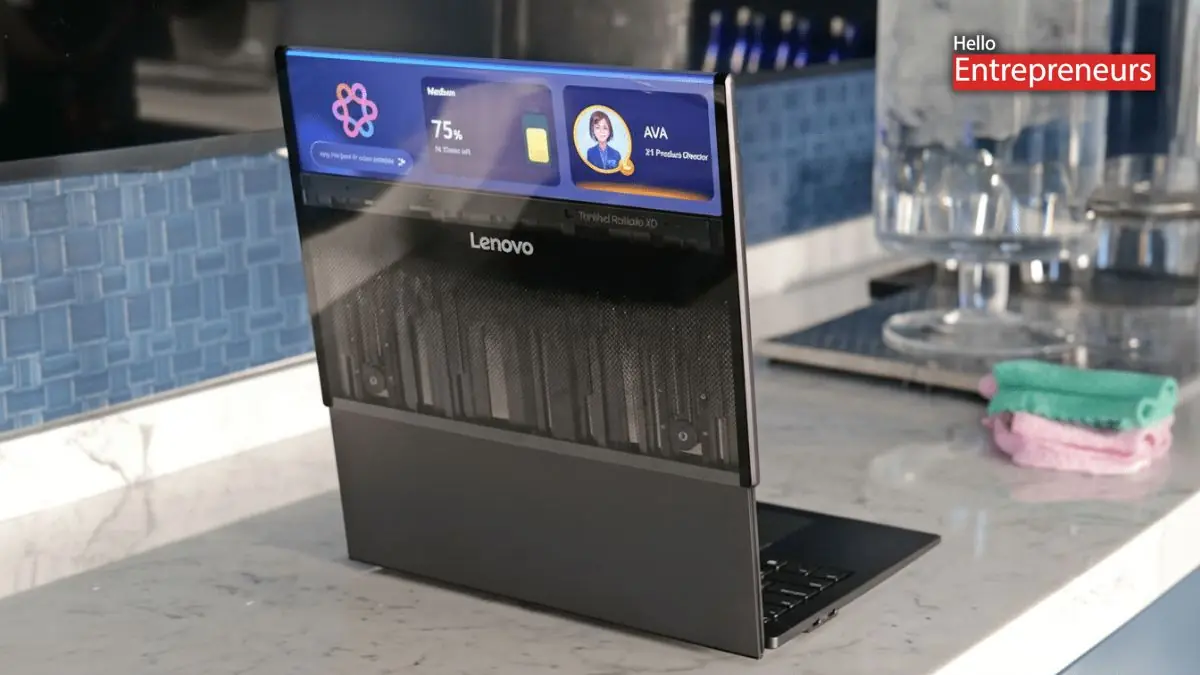
New Delhi: Lenovo has recently showcased its slew of proof-of-concept products at the ongoing CES 2026. In this introduction, Lenovo has highlighted its latest ThinkPad Rollable XD Concept, which features a rollable screen that expands vertically when more workspace is needed. The brand also debuted with the Personal AI Hub Concept, touting it as a central, on-device AI ecosystem. Other announcements include a Lenovo AI Glasses Concept, AI-powered display concepts and several innovative accessory concepts. So now, let’s discuss the products that Lenovo has unveiled.
ThinkPad Rollable XD Concept
The Lenovo Rollable XD Concept builds upon the company’s recent innovative PC designs, including the ThinkPad X1 Fold and the ThinkBook Plus Gen 6 Rollable AI laptop. It features a vertically expanding OLED display that can extend from a compact 13.3-inch laptop screen into a taller 16-inhc workspace with a single button press. The ThinkPad Rollable XD Concept supports Swipe to X touch gestures and voice controls, enabling users to launch applications or switch modes quickly. It features a 180-degree Corning Gorilla Glass Victus 2 cover for durability. The concept PC is equipped with AI-backed features like live translation, voice assistant, multi-modal and lid-closed interactions.
Lenovo Personal AI Hub Concept
The company unveils Project Kubit, dubbed the Personal AI Hub Concept, which is a personal edge cloud device for supporting AI-enabled applications across PCs, smartphones, wearables, and smart home solutions. It comprises two Lenovo ThinkStation PGX compact AI workstations, which are powered by the Nvidia GB10 Grace Blackwell Superchip. The Personal AI Hub Concept sports a touchscreen display and supports voice-based interactions. Lenovo claims its harvests data across platforms, granting individual access to advanced analytics and AI-enabled applications.
Lenovo AI Glasses Concept
Lenovo has also showcased its wearable glasses at the tech trade show dubbed the Lenovo AI Glasses Concept. It is stated to be lightweight smart glasses equipped with built-in displays and on-device AI processing capabilities. Leveraging display, the glasses can overlay contextual information, such as notifications, navigational directions, translations, and some productivity prompts into the user’s field of view. The glasses are powered by the Lenovo Qira platform, offering AI capabilities from paired smartphones and PCs to deliver sub-millisecond live translation and intelligent image recognition.
The Lenovo AI Glasses Concept weighs 45g and can provide up to eight hours of battery life, as per the company. Lenovo claims AI Glasses Concept prioritises low power consumption and smooth pairing with PCs and smartphones. It is positioned as an assistive accessory, rather than for immersive content consumption.
AI-Powered Display Concepts
The latest Lenovo Smart Sense Display Concept showcased at CES 2026 has a 27-inch Ultra HD display that can automatically connect wirelessly to multiple personal devices, including mobile phones, laptops, and tablets. Users can cast control from their devices for multi-screen collaboration. The display supports natural language interaction with the intelligent assistant to access devices and applications through touch or voice commands. It has features like flexible window management and drag and drop functionality.
Smart Accessories
Lenovo has also showcased several innovative accessory concepts at CES 2026. Adaptable Keyboard Concept is a versatile and compact keyboard that supports adjustable stroke and optical actuation controls. The Lenovo Self-Charging Kit Concept is a set of keyboard and mouse, powered by light harvesting technology that operates as low as 50 lux. The mouse is solar-powered and can be charged even with indoor lighting.

