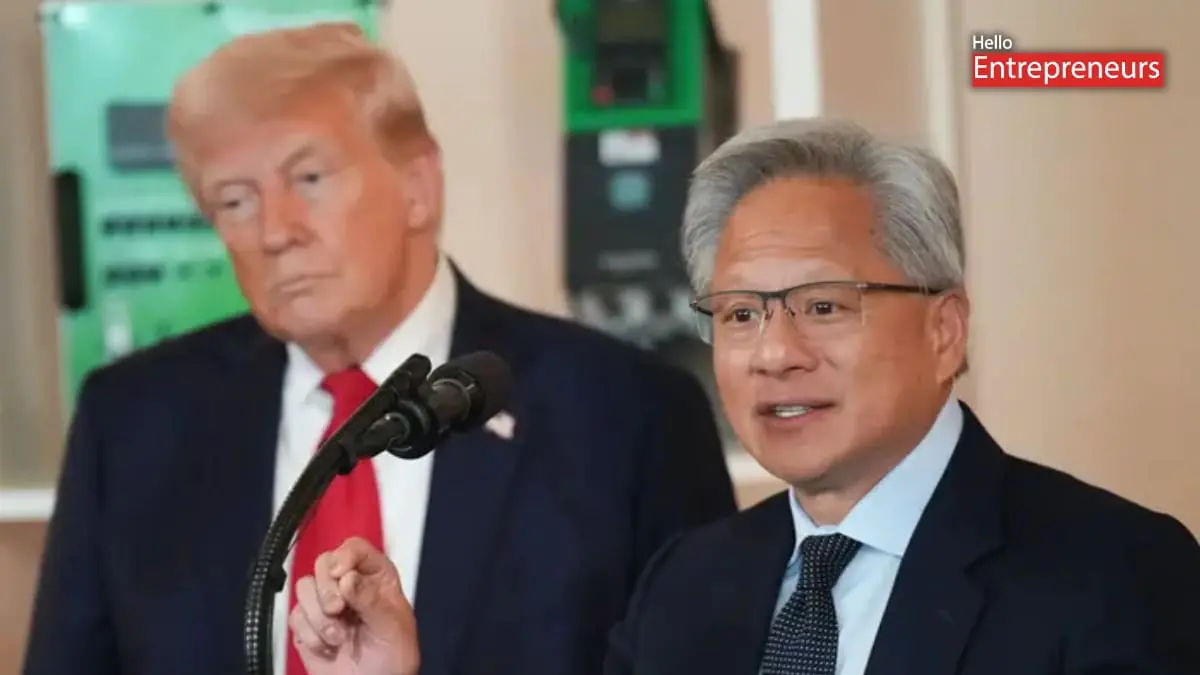








New Delhi: Nvidia CEO Jensen Huang has publicly backed President Donald Trump’s new rule that raises the fee for fresh H-1B visa applications to $100,000 calling it “a great start” toward reshaping U.S. immigration policy and attracting top talent. Huang, who came to the United States with little and built his life from the ground up, framed the discussion around the idea of the American dream and the need to keep that dream meaningful for people who come to the U.S. to build a future.
Huang told podcasters and later spoke to CNBC that while the fee is steep, it establishes a clear threshold. He acknowledged the amount may feel “quite high” but argued it might help reduce illegal immigration and act as an initial filter, a starting point that could force a more careful look at who enters the U.S. tech workforce. He also stressed that America must continue to welcome the brightest minds, since immigration is central to the country’s identity as a place of opportunity.
That endorsement comes with context. Nvidia is one of the largest tech employers that use H-1B workers: in fiscal 2025 the company reported about 1,519 H-1B visa holders among roughly 36,000 employees globally. Huang’s stance therefore mixes personal experience with a leader’s real-world exposure to how global talent fits inside a major tech firm. The White House has clarified the new charge is a one-time fee for new applicants and does not apply to renewals, a detail that keeps current visa holders out of immediate pain but changes the calculus for new hires.
Not everyone agrees. Economists and other tech leaders warned the hike could backfire by driving talent away at a time when competition for skilled people is fierce. Voices like Andrew Ng cautioned that the policy creates uncertainty and could deter global experts. Nobel laureate Paul Krugman warned of risks to long-term innovation, while investors and commentators such as Kevin O’Leary warned the move might hurt startups by making it harder and costlier to bring in engineers and founders. These critics worry the U.S. might trade immediate political gains for a slower erosion of its technological edge.
So how should an Indian-style journalist read this? First, Huang’s view is not pure ideology, it’s pragmatic. As an immigrant executive who directly benefits from global talent, he appears to be balancing national branding (the American dream) with practical workplace needs. Second, the $100,000 figure is symbolic as much as it is financial: it signals a desire for tougher entry rules while leaving room for exceptions, renewals, and company-level hiring strategies. Third, the critics’ point about a possible brain drain is realistic; policy that raises barriers must be paired with clear pathways for talent to come, stay, and contribute, otherwise other countries will pick up the slack.
My take: the debate shows a deeper tension in modern tech policy, between protecting domestic workers and preserving open funnels for global skills. A better compromise would be a calibrated system: meaningful fees targeted at low-priority applicants, faster visas for high-value roles, and stronger domestic training programs so the policy doesn’t simply export innovation to other markets. That would keep the “dream” alive while addressing political pressures at home.