
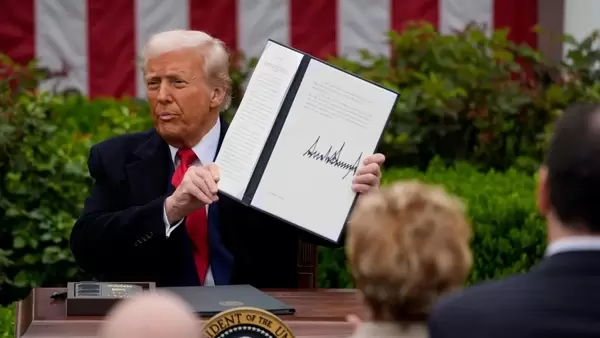








New Delhi: The recent move by former U.S. President Donald Trump on April 2, to introduce new tariffs, has actually rocked financial markets globally. Indeed, the U.S. recently experienced its largest market crash since the COVID-19 era. For consecutive days, Wall Street has been declining, and now people are seriously concerned that we may be on the brink of a worldwide recession. The Dow Jones fell by 5.5%, and the S&P 500 fell by nearly 6% on Friday, investors are certainly shaken.
The market collapse has erased approximately $6 trillion, yes, trillion, of retirement savings and investments. But Trump? He’s totally unaffected. He even referred to it as a “chance to get rich” and made it well known on Truth Social (his own site) that he’s not going to reverse any of his policies.
In his view, these tariffs will strengthen the U.S. economy, boost local industries, and generate more jobs. He also brushed aside the concerns of large corporations, saying they’re not that fussed. But most economists are saying, whatever advantage he’s referring to, it won’t materialize overnight, it will take time, if ever.
China gives it Back with interest
China didn’t waste time in retorting. It imposed a 34% tariff on American products, beginning April 10. Trump, as ever, described China’s action as a “panic reaction” and said it will damage them more than us. China, however, wasn’t finished yet.
They even imposed export bans on rare earth elements such as terbium, gadolinium, and scandium. They are simply extremely critical in the fields of technology and medical technology in the U.S. And this is the kicker: from 2020 to 2023, nearly 70% of rare earths employed by America really originated in China.
So, picture this, if these materials halt coming, then it might give rise to more supply chain troubles. Businesses within the U.S. could lose out in making things go right.
So, What’s the bigger picture here?
It’s not about this U.S.-China trade war being an argument between two giant nations alone. It is impacting economies everywhere in the world. Most professionals are concerned that unless things stabilize quickly, the world is at the verge of a global recession.
The International Monetary Fund (IMF) defines a recession as two quarters (that’s six months) of falling GDP. We’re not officially there yet, but if markets keep crashing and global trade slows down, things could get very tough, especially for countries that are already dealing with economic problems.
Let’s just say, if America and China sneeze, the entire world catches a cold. And currently, both of them are definitely not doing so well.