



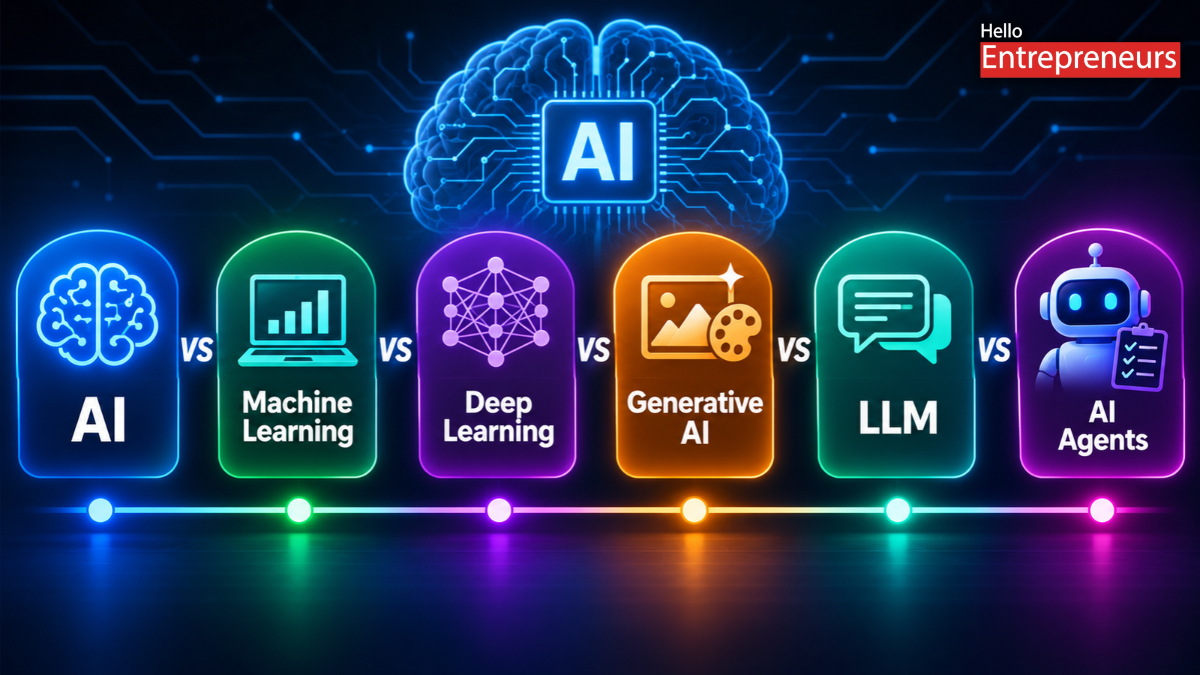
In today’s day and age, AI is manifesting itself in phone applications, office programs, and, yes, in the news headlines, and the terminology is frequently jumbled and thrown around like “AI” and “AI” equals the same thing. They don’t. Several sources has created a commonly shared infographic that helps businesses and leaders understand how to use AI, and outlines the six terms that are often misused, one after the other:
Artificial intelligence: the umbrella
This is the general category of AI. It encompasses any system designed to emulate the processes of human intelligence, such as reasoning, learning and decision making. The infographic presents an algorithm development process with simple steps: formulate problem statement, gather data, select method, create algorithm, train model, fine-tune performance, monitor results, integrate tools and check logic. All items in the remainder of the list are covered by this item.
Machine learning: learning from data
Machine learning is a subcategory of the broader field of AI. These systems learn patterns from data, and improve their performance with experience without being explicitly programmed. The steps in the chart start with data collection and preprocessing, then split the data sets and pick a model, followed by result analysis, model parameter tuning, and then deployment and frequent retraining of the model. One common example is a spam filter that gets better the more you mark as spam.
Deep learning: many layers
Deep learning is a type of machine learning that uses neural networks with multiple layers. The layers allow a system to learn complex patterns without assistance – hence the ability to handle images, speech and language. The infographic contains the following steps to get a data set, normalizing input, modeling the architecture and selecting activation functions. It also includes loss setting, GPU usage, loss prevention, model accuracy assessment, network training and fine-tuning the model. The significant difference from the previous machine learning approaches is the high compute needs.
Generative AI: making new things
Generative AI produces content that is original, like text, images, sound or code, but is based on existing data. This classic approach would classify a photo as a: cat. A generative one can create a cat that never had an existence. The workflow in the chart comprises collecting data, training the model, interpreting the patterns, learning structure and sampling. Then it goes on to deploy use cases, fine-tune responses, add prompts, filter outputs and assess quality. The output is very reliant on the prompts, so they are important there.
Large language models: the text specialists
LLMs are deep learning models that have been trained on a large volume of text data to comprehend and produce human-like language. They are responsible for popular chatbots. If you are constructing one, you need a pretrain dataset, text tokenization, transformer construction and stacking layers and attention setting, according to the infographic. Next, training context, task validation, token optimisation, serving via API and enabling query. One of the types of generative AI is an LLM, which is based on language, not images or sounds.
AI agents: from answers to action
The last item is the AI agent. The infographic defines it using the same definition it has for AI in general, which is a system capable of mimicking human intelligence; but in practice, the workflow displays the difference. An agent establishes a goal, recognizes context and activates a planner, then queries an LLM, chooses which tools to use, executes actions, observes the outcome, writes to memory, repeats the loop of tasks, and progresses towards the goal. If the chatbot responds to a question, the agent performs a multi-step task, like booking a trip or processing a large stack of invoices, and monitors his or her own work.
How the pieces fit
There is a simple hierarchy. AI is the whole field! There are various methods to build AI, one of them being machine learning. One of the methods of machine learning is deep learning. One application of deep learning is generative AI, which creates new content. LLMs are language generative models. Agents typically are placed on top of an LLM and provide it with tools, memory and planning so it can perform actions, instead of just responding.
This ladder is helpful for business owners and students to check vendor pitches. A product labeled “AI-powered” may be an AI rules engine, an AI prediction model, or an AI agent, and the cost, risk and benefit varies significantly among these different products. It’s a good place to start by asking, which layer does a tool belong to?
As technology is disseminated, tools are not the only thing that are important, clear vocabulary is too. It is important for people to recognise the location of each term so they can determine what a system can and cannot achieve.

