



Everyone talks about product-market fit. Fewer people talk about team-culture fit — the alignment between how a company says it operates and how the people inside it actually experience working there every day.
For early-stage startups, this gap is manageable. When you’re ten people sharing one room, culture happens organically. The founder sets the tone. Trust builds through proximity. Feedback happens in real time. No one needs a workshop to know what the company stands for.
Then the company grows.
The 30-to-100 Problem
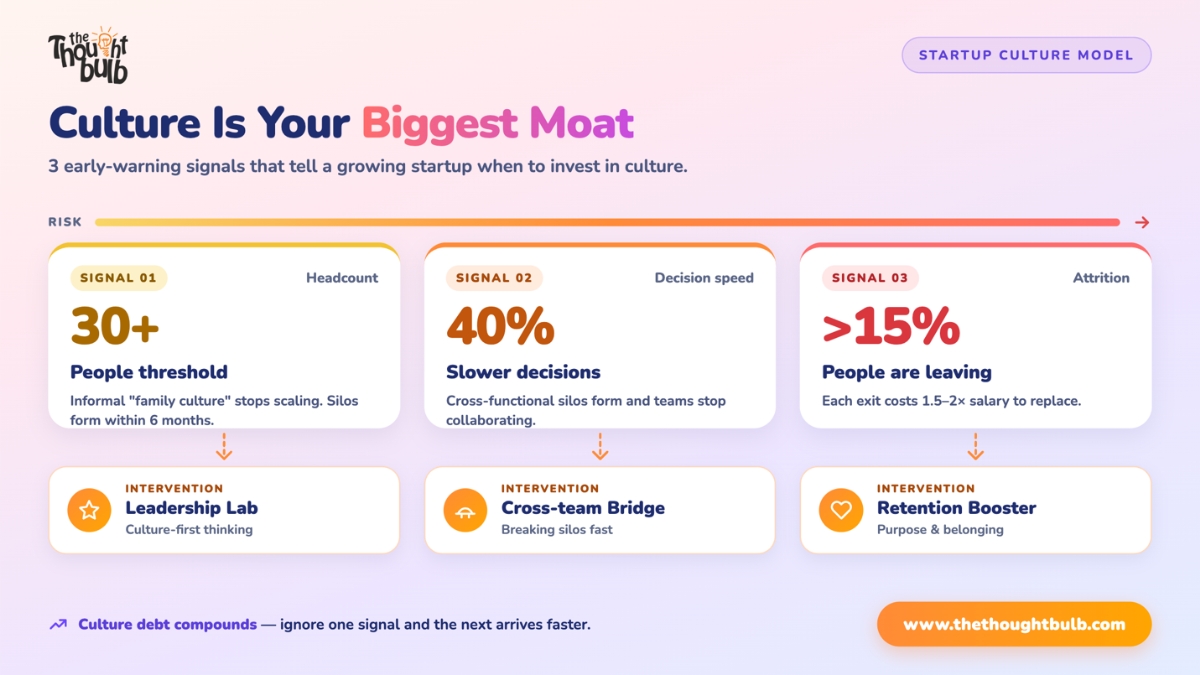
Something predictable happens when a startup scales past 30 people. New hires arrive who didn’t experience the founding story. Remote and hybrid structures fragment daily interaction. Cross-functional friction starts showing up in Slack threads and missed deadlines. The culture that felt obvious at ten people suddenly needs to be actively maintained.
Most founding teams notice this somewhere between 30 and 100 employees — but by then, the patterns are often already set. Silos have formed. Communication gaps have hardened. The informal trust that held everything together has thinned out.
The startups that get ahead of this don’t wait until culture breaks to fix it. They build structured touchpoints into how teams interact — before the problems become expensive.
Why a Team Day Isn’t Enough
The instinct is usually to book an offsite. Go somewhere nice, do some activities, have a group dinner, come back recharged. This isn’t wrong — but it’s not sufficient on its own.
Without structure, an offsite is a social event. Social events build goodwill, but they don’t address the underlying patterns creating friction. They don’t give people shared language for how to disagree well, or tools for working through misalignment. And they don’t produce the kind of shared experience that changes how people show up the following Monday.
What changes how people show up is experiential learning — activities that deliberately put teams into situations that mirror real workplace dynamics: pressure, ambiguity, resource constraints, the need to communicate clearly under time limits. When teams work through these situations together, they surface patterns they wouldn’t have noticed in a meeting room.
The key word is deliberately. The activity itself isn’t the point. What it reveals, and what you do with that revelation, is the point.
Making It Work on a Startup Budget
The assumption that effective team building requires an expensive offsite is outdated. Some of the highest-impact programmes are half-day, in-office sessions — structured, facilitated, and designed around the specific challenge the team is facing right now.
The criteria for choosing the right format aren’t about budget; they’re about objectives. A team navigating rapid hiring needs something different from one struggling with decision-making speed. A cross-functional group that barely interacts needs a different design from one that works closely but communicates poorly.
Providers who do this well start with a discovery conversation, not a brochure. They ask what’s actually going wrong, then build something targeted. There’s a wide range of experiential team building activities available across formats — indoor, outdoor, virtual, and hybrid — designed for teams at different stages of growth, from 10 to 500+ participants.
What Good Looks Like
Three things distinguish an effective team building investment from an expensive social event:
1. A clear objective set before the programme. If you can’t articulate what you want to be different after the session, you’re not ready to run one.
2. A facilitator who can read the room. The best facilitators aren’t entertainers — they’re practitioners who know how to hold a group through discomfort, draw out insight, and connect what’s happening in the activity to what’s happening in the business.
3. A structured debrief. The conversation after the activity — where teams reflect on what they noticed, what surprised them, and what they want to carry forward — is where the real value lives. It’s the most underrated element of any team building programme.
Culture Is Not a Retreat. It’s a Practice.
The mistake most founders make is treating team culture as something you establish once and then maintain passively. In reality, culture is constantly being renegotiated by every decision, every communication pattern, every conflict that is or isn’t addressed.
Intentional team building — especially for companies in high-growth tech hubs like Bangalore, Mumbai, Pune, and Hyderabad, where competition for talent is intense and team turnover can be brutal — is one of the most practical ways to build the kind of culture that compounds. For companies based in Bangalore specifically, investing in team building in Bangalore has become a measurable retention strategy, not just a perk.
The startups that get this right don’t have less friction. They have better frameworks for working through it. And that, more than any product advantage, is what scales.

