



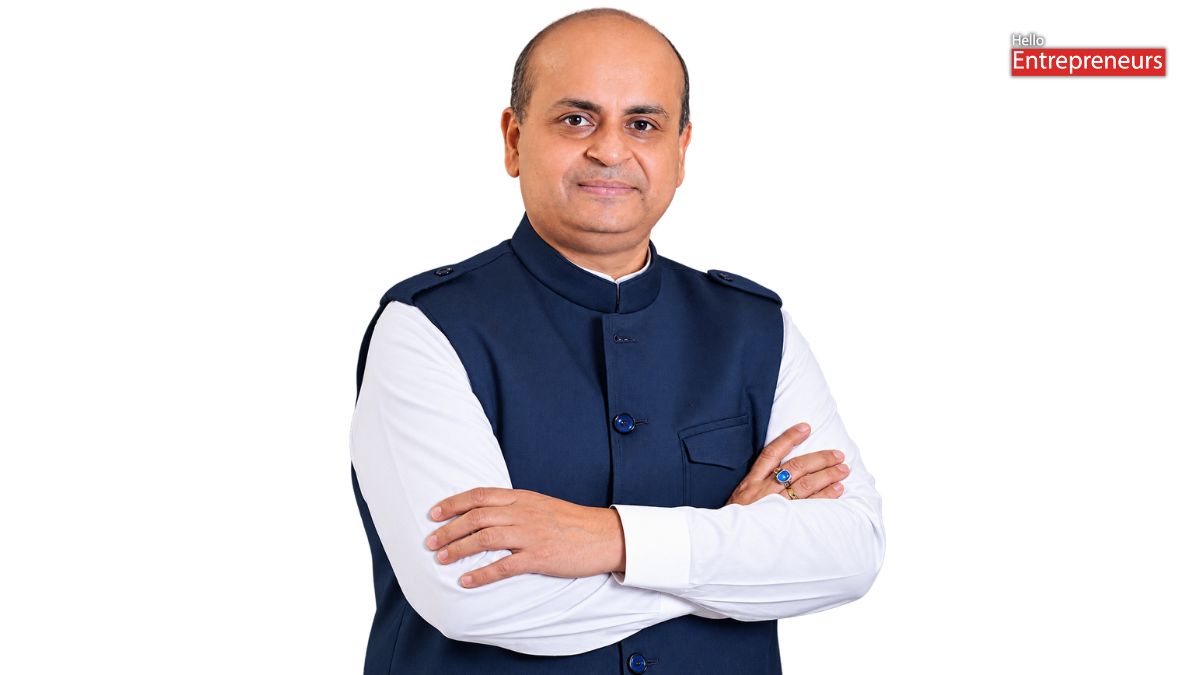
With nearly three decades of experience in institution-building, Shailendra Singh, associated with Pratap University, has expanded his vision beyond education to healthcare and sports. In an interaction with Hello Entrepreneurs, he reflects on the purpose of education, the evolving role of technology, the importance of leadership and the opportunities artificial intelligence presents for India’s youth. He also shares his thoughts on nurturing entrepreneurship, building a culture of trust and preparing students for a future where learning goes beyond degrees and classrooms.
1. Shailendra ji, you’ve spent nearly 30 years building institutions. When you look back today, what gives you more satisfaction, seeing thousands of students graduate, or seeing them come back years later and tell you, “Sir, you changed my life”?
Though both cases bring life-altering satisfaction, the journey becomes worthwhile when a student returns after a couple of years and says the opportunities offered changed their life. A diploma is the final point of an educational journey, but helping an individual find their potential can make a difference for many years ahead. When we first started the venture, our idea was not merely to create schools, but to help young people achieve independence, develop, and contribute positively to society. Each successful graduate of ours serves as a reminder of the reason we started.
2. You’ve built schools, colleges, a university, a hospital, and now even entered sports. Most people spend a lifetime building just one institution. What keeps pushing you to take on the next challenge instead of slowing down?
For me, every new organisation starts with a chance to make a positive impact. Although education, health care, and sports seem to be different sectors, they have the same objectives. They all have to cultivate human potential. The country, India, is blessed with a lot of talent, and it is our duty to provide it with a suitable environment. When I identify an unaddressed demand or a chance to bring help to a larger number of people, it gives me the motivation to act. In my opinion, institution formation does not mean arriving at a certain point in life but implies responding to the needs of society continuously.
3. Everyone is talking about AI replacing jobs. As someone who works closely with students, are you worried about the future… or do you think this is actually the biggest opportunity for India’s youth?
My perspective is that AI represents a crucial chance for the younger generation in India, if only we instruct them to apply this technology creatively, instead of fighting against it. Whenever a major technological transformation occurs, there comes a shift in jobs, openings for new job opportunities, and the need for development of new skills. Therefore, I strongly advocate the inclusion of the concepts of critical thinking skills, creativity, and problem-solving capabilities into the educational system along with technological knowledge. Another important task is to ensure that students are ready for new types of jobs that have not been invented yet. The real challenge is not artificial intelligence per se, but our capacity to teach and inspire young people to properly and creatively use this technology.
4. Shailendra ji, if a student walked into your office today and said, “Sir, I don’t want a degree, I just want to build something big,” what would your advice be? Would you still tell them to complete their education?
The first step I would take is to find out what the student wants to create, why they want to create it, and how ready they feel for it. Encouragement should be given to work toward their goal while explaining that education is not all about getting a degree, as it entails so much more than that. Education imparts self-discipline and insight, or the ability to analyse situations properly. To be an entrepreneur, one has to be brave but also knowledgeable, as well as experienced enough to learn from failures. Students should be advised to continue learning.
5. You’ve seen education evolve from classrooms with blackboards to AI-powered learning. What’s the one change in today’s education system that excites you the most… and what’s one trend that genuinely worries you?
The most exciting aspect for me is how technology has the potential to make education easier to access, more practical and personalised. By using AI in education, students get to learn at their own speed while getting exposed to the real world beyond the content of the classroom.
It, however, shakes me to think that education can transform into a contest for gaining grades, certificates and jobs at the cost of inspiration and critical thought. Technology should serve to enhance the relationship between the teacher and the student. Education is not just about becoming a professional; it is about becoming a professional and good citizen.
6. Building institutions isn’t just about infrastructure, it’s about people. Over the years, what’s been your biggest leadership lesson when it comes to managing thousands of students, teachers, doctors, and professionals under one vision?
My primary learning experience in leadership is that in order to achieve a collective vision, it needs to be based on trust, accountability, and the right people. No one can manage a large organisation on their own. There should be teachers who motivate, doctors who practice compassion, high-level specialists who care about their tasks, and leaders who are aware of their obligations. What I have realised after some years of experience in leadership is that leadership is not about making all the decisions; it’s about making people able to make the right decisions or keep them aligned with the goal. Though systems and infrastructure have their importance, it’s the people who make an organisation what it is.
7. You also stepped into sports with the Dehradun Warriors. Was that purely a business decision, or do you genuinely believe sports can shape leadership and character just as much as classrooms can?
My interest in sports stems from my conviction that education is enhanced by sports. Sports teach lessons which cannot always be learned through books, such as discipline, teamwork, resilience, respect for rules, and the ability to cope with both winning and losing. With Dehradun Warriors, we aim to harness sporting talent and make a contribution to the sporting ecosystem. Businesses need to remain sustainable in order to survive, but the more important aspect of sports is the impact that it has on people and the opportunities created.
8. Shailendra ji, if I visited one of your campuses without telling anyone who I was, what kind of culture would you want me to experience in those first five minutes?
I would like them to experience an atmosphere of transparency, determination, and potential. They should see learners who feel free to inquire, professors who are friendly, and an ambience where learning goes beyond textbooks. The students should feel that discipline and determination can exist along with kindness and respect. The university must not be only a place for learning and passing exams. It should be a place for finding themselves and what they can become in the future. Without a doubt, the culture of the institution is expressed in the way people communicate with, learn from, and treat each other.
9. One last question. If you had the chance to redesign India’s education system from scratch, what’s the first thing you’d remove… and what’s the first thing you’d introduce to make students truly future-ready?
Personalised learning is a concept that completely negates traditional paradigms of education, as is evident from experience. Individual mindset, beliefs and motivation to study show that, therefore, each individual has a unique approach to the educational process. And our academic system should be able to promote such an individualised process. I would introduce new approaches to education right from school. The process of learning would include the use of technology in the classroom, scientific inquiry, and practice solving real-life problems. Students would be able to practice various techniques of the educational process, co-create knowledge, and learn from mistakes.

