



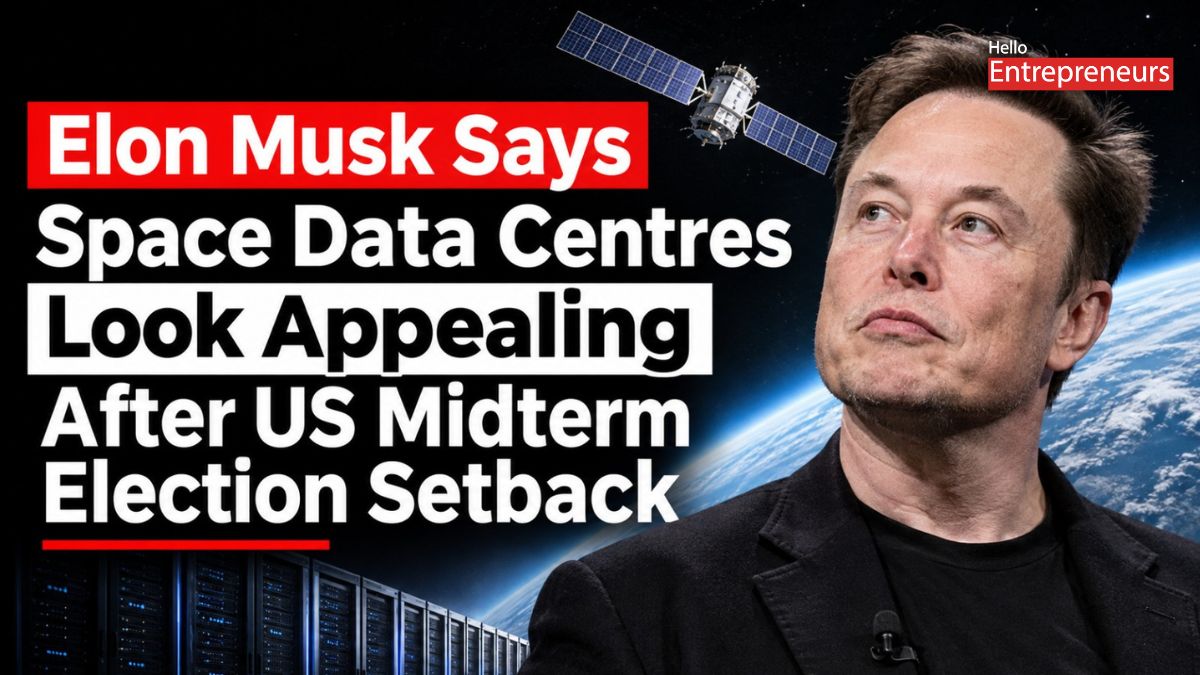
Musk’s remarks come as Democrats make significant gains in the US midterm elections, raising questions about the future of data centre expansion in Texas and other states.
Elon Musk has suggested that space-based data centres are becoming more attractive following the Republican Party’s disappointing performance in the US midterm elections, reviving his vision of moving artificial intelligence (AI) computing infrastructure beyond Earth.
“Data centers in space looking pretty appealing right now,” Musk wrote on X on Wednesday, November 4, following the election results.
The Tesla and SpaceX chief executive also posted, “Guess my election-interfering space lasers didn’t work this time,” in an apparent reference to his political involvement and support for Republican candidates.
According to Axios, Musk spent an estimated $445 million supporting Republican candidates during the election cycle, making him the largest individual donor in modern US political history. However, the candidates he backed suffered significant losses, including in Texas, where Democrat Gina Hinojosa won the governor’s race.
The results could have implications for Musk’s business interests, particularly in Texas, where Tesla and SpaceX have major operations and the technology industry is expanding its AI infrastructure.
Why Musk is looking towards space
Musk’s comments also reflect his broader ambition to shift AI computing beyond Earth. In a series of posts on X, he argued that future superintelligence computing would overwhelmingly take place in space.
He has previously suggested that space offers advantages for cooling large computing systems. According to Musk, an aluminium radiator facing away from the Sun could achieve heat dissipation of around 1,300 watts per square metre, compared with approximately 250 watts per square metre generated by solar panels.
The idea is to use the cold environment of space to manage the heat produced by powerful AI processors while relying on solar energy to power the systems.
However, the proposal has faced technical criticism. In a recent exchange on X, Musk dismissed a user who questioned his understanding of heat transfer in space.
The user argued that a vacuum acts as an insulator and that heat can escape only through radiation, making large orbital data centres difficult to cool.
The exchange highlights the engineering challenges involved in building and operating computing infrastructure in orbit, including radiation protection, power supply, heat dissipation and the cost of launching equipment.
Data centre expansion faces political challenges
The election results could also affect the economics of building AI infrastructure on Earth.
Texas has become a major destination for technology companies seeking to expand data centre capacity. However, growing concerns over electricity consumption, water usage and the impact on local communities have prompted calls for tighter regulation.
According to Axios, Hinojosa’s victory could affect the outlook for data centre development in the state, although the impact on Musk’s companies remains uncertain.
The political debate comes as major technology companies continue to invest heavily in AI infrastructure, with data centres requiring substantial amounts of electricity, cooling systems and specialised computing hardware.
Can space-based data centres become a reality?
Musk’s comments have sparked mixed reactions on X. Some users welcomed the idea of moving computing infrastructure into space, while others questioned whether it would address more immediate concerns on Earth.
One user argued that people were more concerned about economic and social challenges than space exploration. Another suggested that orbital infrastructure should be designed to generate and collect additional energy.
Others questioned the feasibility of launching and maintaining massive data centres in orbit.

