



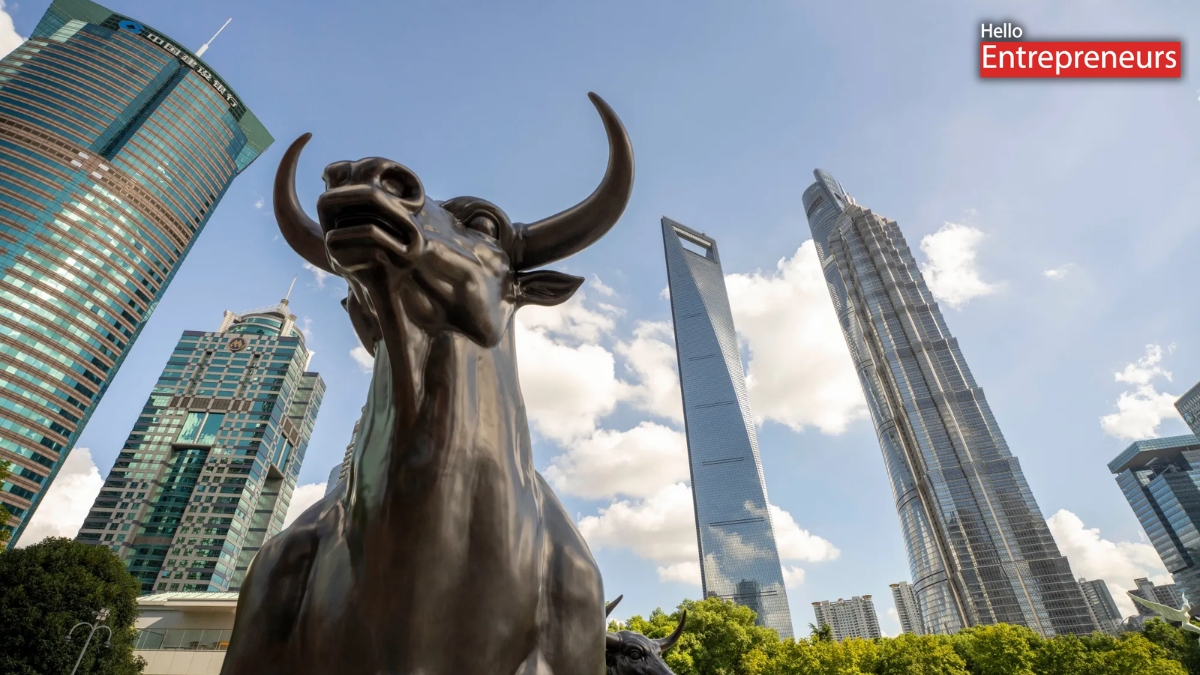
New Delhi: China’s stock market opened Tuesday with another ugly slide. According to a summary circulating on X, the Shanghai Composite fell about 1.5% in the opening minutes, and more than CN¥1.58 trillion, roughly $237 billion, evaporated from market value. I couldn’t confirm those exact figures against an exchange or wire source. The same summary also describes the day’s loss as anywhere from 0.7% to 1.2%, which doesn’t line up with 1.5%. Treat the numbers as rough, and notice that nobody quite agrees on them yet.
The direction is clear enough, though. The slide is now in its seventh week. The same summary puts total losses near CN¥16 trillion over four months, with the tech-heavy STAR50 down about 40% since July. That is also unverified.
What is verifiable is what happened last Friday. The Shanghai Composite fell 1.44% to close at 3,599, and the Shenzhen Component lost 2.73% to 10,834, both at their lowest levels in more than a year. Over October, Shanghai dropped 6.33% and Shenzhen plunged 15.94%. That Shenzhen number is the one to stare at.
Support is there. Buyers aren’t.
It isn’t that Beijing is sitting still. In July, authorities mobilized fresh support measures to shore up the technology sector after a sharp selloff, and Shenzhen surged 4.81% in a day. Cambricon jumped more than 11%. In late October, increased state-backed ETF buying helped the market erase earlier losses.
Every one of those rallies faded. That’s the pattern. Policy support can buy a day, sometimes a week. It can’t make a company profitable, and that’s the actual question hanging over China’s AI trade.
The profitability test
The AI boom was priced on promise: chips, optical modules, data centers. Names like Cambricon, SMIC and Zhongji Innolight were bid up on the idea that demand would arrive and earnings would follow. Now the earnings are arriving. In mid-October, investors were turning their focus to quarterly releases for clues on corporate margins and fundamental demand. Margins are where a story either holds or doesn’t. Sell-side optimism is cheap. Cost pressure isn’t, and investors were already weighing mounting cost pressures when the October slide picked up speed.
Is the rally losing momentum? Honestly, it looks past that. This is closer to a repricing, and repricings tend to overshoot in both directions.
A bigger problem underneath?
This is the harder question, and I’d be careful. A falling stock market isn’t the economy. But the screenshot’s own framing, doubts over profitability and a weak economy, points at something real. Back in September, one report described investors watching trade and inflation data amid a slowing economy. If households and companies feel poorer, spending drops, and the tech sector loses the domestic demand it was supposed to grow into. Or the market could simply be fixing a bubble while the real economy muddles along. Both readings fit the data so far. Anyone telling you they’re certain is guessing.
What it means abroad
For global tech investors, the lesson is more about contagion than direct exposure. Chinese AI names trade in a different ecosystem from Nvidia or the US hyperscalers, but sentiment doesn’t respect borders. Earlier this year, tech and war fears dragged Asian markets down together, with the Star50 opening 4.8% lower in one session. A prolonged China tech rout can chill risk appetite across Asia, especially in Korea and Taiwan, where chip stocks carry heavy weight. It also hands skeptics a talking point: if China’s AI trade can’t hold up even with state help, how much of the global AI valuation story is just momentum?
I don’t think that’s a fair leap yet. China’s situation has its own ingredients, from regulatory uncertainty to the economy to a market that leans heavily on retail enthusiasm. But the question will get asked.
For now, watch two things. Whether the state ETF buying keeps showing up, and what the next round of earnings says about margins. If the support runs out and the numbers disappoint, last Friday’s lows won’t hold.

