



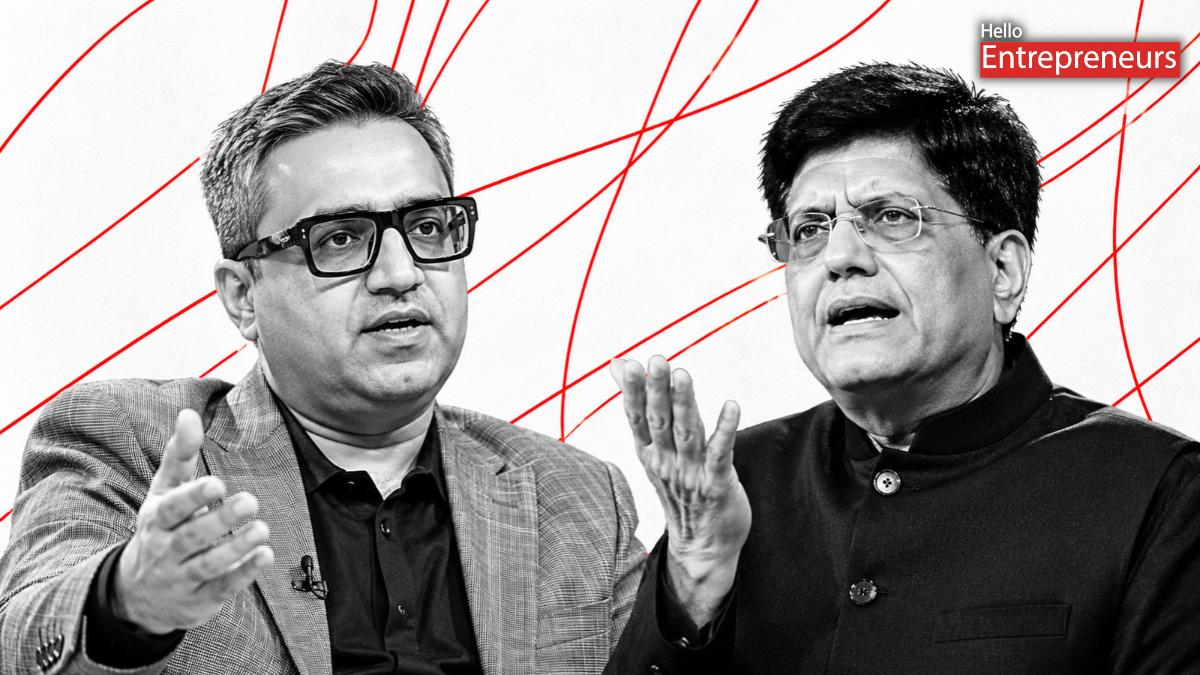
New Delhi: Piyush Goyal wanted to make a point about how India is seen abroad. Ashneer Grover made a different point in about fifteen words, and the second one is the one people are sharing.
It started with a speech. The Union Commerce Minister said that when Indians used to go abroad, the passport carried little value, and people looked down on them. That had changed, he said, and he called it a “360-degree change.” To back it up, he told a story about meeting Germany’s Foreign Minister. Goyal says he told the German minister that Germany needs 90,000 Indian workers every year, and the minister replied that no, Germany needs far more than that.
The clip was picked up by news apps, including a short summary on Inshorts, and then someone noticed the maths.
Grover, the Shark Tank India judge and BharatPe co-founder who never runs short of opinions, posted a reply in Hinglish: “I think you meant 180 degree sir jee. 360 pe to vaapis wahi pahuch jaate hai!” Roughly, a 360-degree turn brings you back exactly where you began. If the old situation was Indians being looked down on, a full circle means you’re back to being looked down on. A 180 is a reversal, which is what Goyal clearly meant.
It’s a small joke. It works because Goyal’s phrase is one almost everyone uses loosely. “360-degree change” turns up in speeches, ads and appraisal meetings constantly, nearly always when the speaker means the opposite of what the geometry says. Grover just said so out loud, to a minister, in public.
The exchange was picked up quickly, and according to the Grok summary on X, Congress leaders joined in with jabs of their own, some on the arithmetic of the phrase and some on the government’s messaging more broadly. I couldn’t verify individual posts from those leaders, so I’ll leave names out. But the pile-on was predictable. A minister’s verbal slip is easy material, and nobody needs much encouragement.
Still, it’s worth separating the joke from the claim underneath it, because the claim is the more interesting part.
Has India’s image abroad changed, or has its economic weight? Those are related, but they aren’t the same thing. A passport’s strength is usually measured by how many countries let you in without a visa, and that depends on diplomatic agreements and perceived migration risk more than on reputation. Reputation of workers and professionals, meanwhile, builds slowly through people actually doing jobs: engineers, nurses, IT staff, students who stay and work. Germany’s demand for skilled labour is real. It has an ageing workforce and has been openly recruiting from India and elsewhere. That’s an economic need on Germany’s side as much as it is admiration for India.
So Goyal’s anecdote can be read two ways. Supporters would say it shows Indian talent is now actively wanted, which is a clear step up from being tolerated. Skeptics would say that being wanted as labour isn’t quite the same as being respected, and that a country exporting workers because jobs abroad pay better has a domestic question to answer too. Both readings can be true at once. I don’t think the story settles it.
Grover’s quip, whether he intended it or not, lands somewhere in that gap. Read generously, it’s just pedantry about a figure of speech. Read less generously, it asks whether the situation has really turned or just come back around.
What happens next is probably nothing. Politicians fumble phrases and moves on. But the minister’s anecdote and the businessman’s joke now travel together, and anyone who sees one is likely to see the other. For Goyal, that’s a mildly annoying outcome. For the broader debate over how India should present its workforce to the world, it’s at least a free reminder that the phrase “full circle” has two meanings.

