



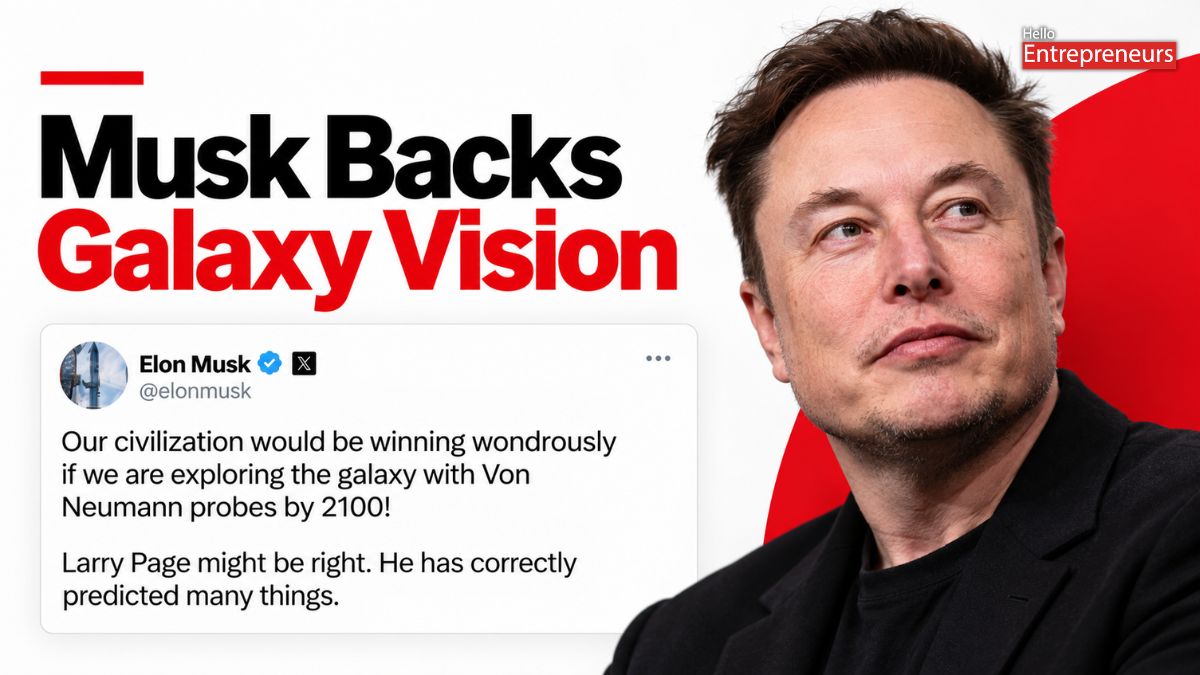
New Delhi, October 29, 2026: Elon Musk has reignited discussion about the future of artificial intelligence and interstellar exploration after responding to a video in which Microsoft AI CEO Mustafa Suleyman recalled Google co-founder Larry Page’s ambitious prediction about exploring the galaxy by the end of the 21st century.
Reacting to the video shared on X, Musk wrote, “Our civilization would be winning wondrously if we are exploring the galaxy with Von Neumann probes by 2100!”
He added, “Larry Page might be right. He has correctly predicted many things.”
The remarks followed Suleyman’s appearance in a conversation with biographer Walter Isaacson, recorded on October 12, 2026, during which he revisited an encounter involving Page and Musk at SpaceX in 2015.
Larry Page’s Prediction During a SpaceX Meeting
Suleyman recalled attending a meeting of an artificial intelligence ethics and safety board established following Google’s acquisition of DeepMind in 2014. Musk had been selected as one of the independent members.
Discussing a lunchtime conversation with Page, Suleyman said, “I was sitting next to Larry. You know, obviously, he was suspicious of me as well because he was like, ‘You know, you’re one of those speciesists.’”
He then recalled Page explaining his vision for advanced technology.
“And he said, ‘You know, I think that what you don’t understand, Mustafa, is that, by the end of the century, I’m going to be exploring the galaxies at the head of a von Neumann probe.’”
Suleyman described such a probe as “a kind of self-propelling, kind of robot that is able to gather energy from space as it’s, you know, careening through the light years.”
The discussion also touched on AI development and the origins of OpenAI. Referring to Musk’s involvement in the earlier safety board, Suleyman remarked, “No idea if that had an influence on the founding of OpenAI or not.”
What Are Von Neumann Probes?
Named after mathematician John von Neumann, these hypothetical spacecraft could theoretically travel between star systems, collect resources and manufacture copies of themselves.
Such self-replication could allow robotic exploration to expand across enormous distances without requiring separate launches from Earth for every mission.
However, the technology remains theoretical and would require significant advances in autonomous manufacturing, robotics, propulsion and artificial intelligence.
NASA Data Shows the Scale of the Challenge
According to NASA, Proxima Centauri, the closest star beyond the Sun, lies approximately 4.24 light-years, or 40 trillion kilometres, away.
NASA’s Voyager 1 spacecraft, launched in 1977, travels at approximately 61,000 kilometres per hour. At comparable speed, reaching Proxima Centauri would take more than 70,000 years.
The Milky Way spans approximately 100,000 light-years, while the Andromeda galaxy is around 2.5 million light-years away.
These distances illustrate the enormous technological breakthroughs required to make Page’s century-end vision feasible.

