



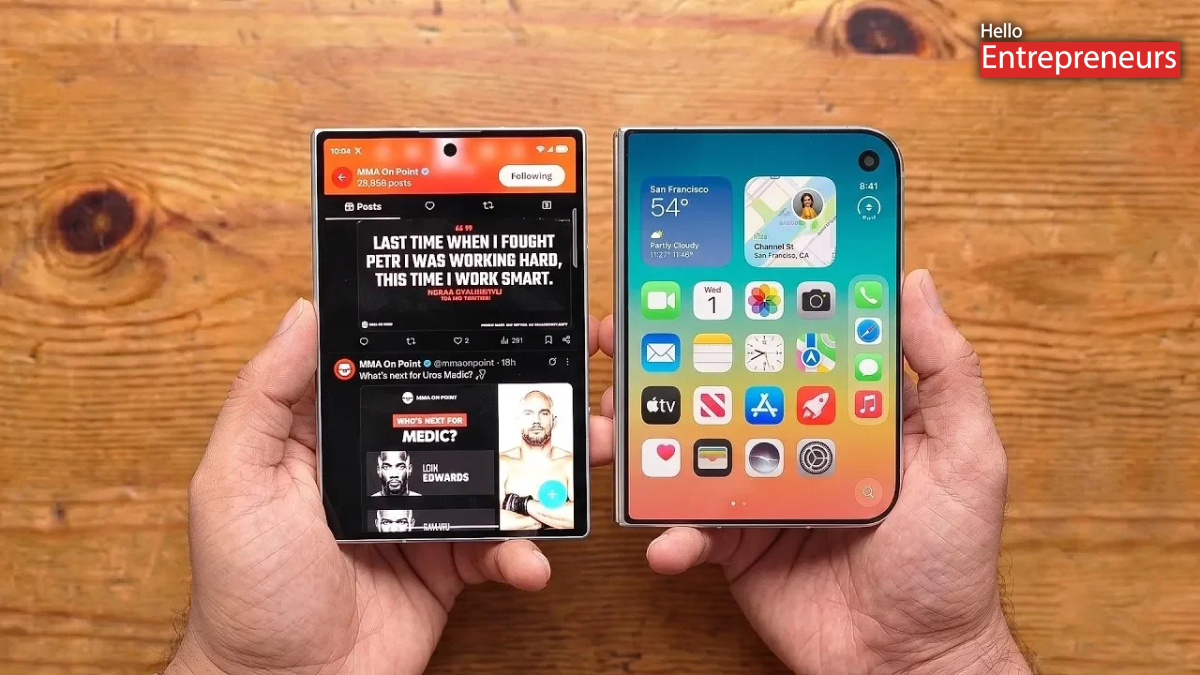
New Delhi: Apple’s iPhone Duo went on sale October 23, three days ago. So anyone telling you it flat-out beats Samsung’s Galaxy Z Fold 8 “in real life” is getting ahead of the evidence.
The early coverage is strong, though, and that’s where the noise comes from. Apple’s pre-orders opened October 16, with the phone arriving a week later. Nearly everything written so far comes from carefully managed hands-on sessions at Apple Park, not weeks of ordinary use.
Start with the crease, because that’s what everyone obsesses over. Some early reports says no visible crease even when the device was bent or fully folded, unlike the obvious crease on the Z Fold 8. Others are less breathless. Reports said hands-on videos show the crease is quite clearly visible from certain angles, though head-on it nearly disappears. Sources landed in between, with a headline saying the crease is still there, but barely. So “creaseless” is marketing talk. “Much better than Samsung’s” is closer to what people are actually seeing.
Durability is a cleaner win. The Duo carries an IP68 rating, while the Fold 8 is only rated IP48. That’s a real difference if you ever take a phone near sand or a pool.
Then the costs. The Duo is heavy. It weighs 254g and is 11.3mm thick folded, making it 53g heavier and 1.6mm thicker than the Fold 8. One reviewer found one-handed tablet use possible but awkward for smaller hands. Hardly a dealbreaker, but Samsung’s version is plainly easier to carry around all day.
Cameras are where Samsung pulls ahead. The Duo has a pair of 48MP cameras, but there’s no dedicated telephoto lens. The Fold 8 has one. If you zoom a lot, that matters more than any megapixel count.
Multitasking is another gap. The Duo supports only two Split View windows at a time, while the Fold 8 can run up to four apps at once. Samsung also offers DeX desktop mode, which the Duo has no equivalent for. Apple’s argument is polish rather than raw flexibility: apps work when the phone is open, closed or half-folded, and the hinge holds angles. Samsung’s hinge, by one account, only stops at fully open or fully closed. Whether that smoothness beats Samsung’s extra windows depends on how you use a phone.
Battery is the big unknown. Apple claims up to 31 hours of video on the inner display, and Stern noted that its claims tend to run conservative. But reports, per one summary, found the Duo’s battery life shorter than the iPhone 18 Pro Max’s even on the outer screen. Nobody has run a proper week-long test yet.
Performance is similar. Outlets expect the A20 Pro to be faster, but one admitted they hadn’t benchmarked it yet. Expect, not measured.
Price is also not a small thing. The Duo starts at $1,999. The Fold 8 retails at $1,899. In India the gap is far wider: ₹2,99,900 against ₹1,74,999. That’s a serious premium for an iPhone that, on paper, gives up a telephoto camera and some multitasking.
Supply may be tight too. Several reported production difficulties ahead of launch, with early output expected to be limited. Part of the hype could simply be scarcity.
So is it hype? Partly. The reviews really are positive, and the crease and durability gains are real. But “beats the Fold 8” is mostly a comparison of spec sheets and short demos. Samsung is lighter, thinner, more flexible on software and better equipped on cameras. The Duo’s case is strongest for people already inside Apple’s ecosystem who want a foldable that feels like an iPhone.
For everyone else, waiting for full battery and long-term crease tests is cheap insurance on a $2,000 purchase.

