



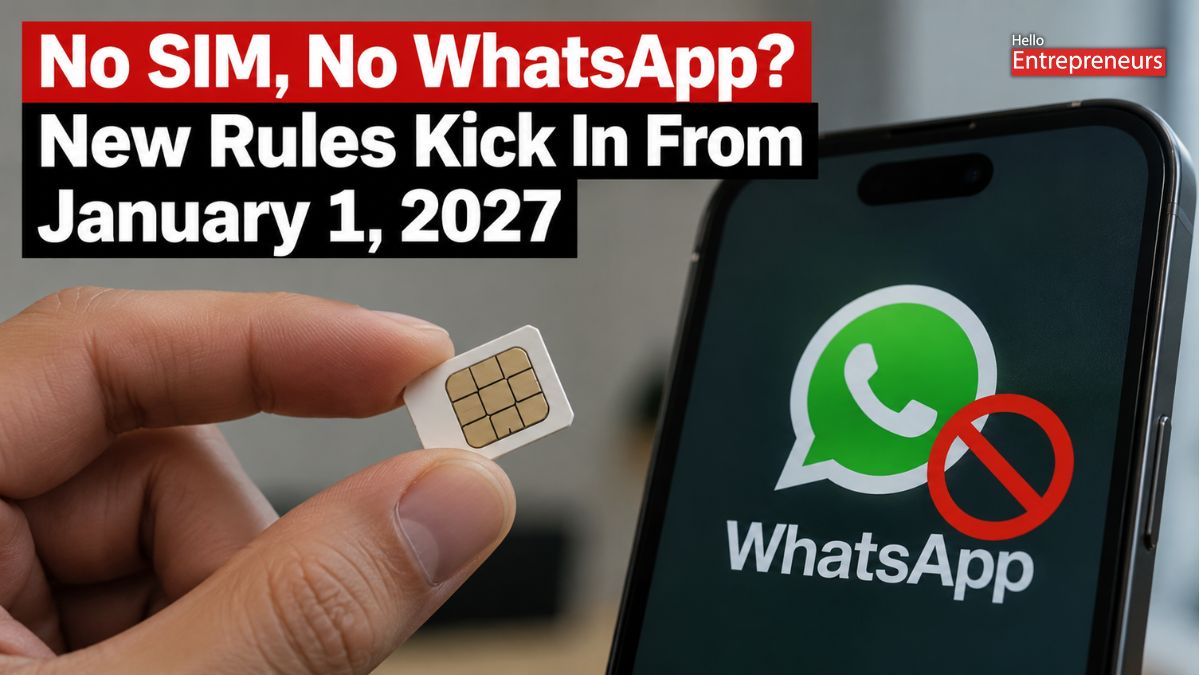
New Delhi: WhatsApp and Telegram users in India could face changes to how they access messaging services from January 1, 2027, as the Department of Telecommunications (DoT) prepares to enforce SIM-binding requirements. The directive, issued on November 28, 2025, requires messaging platforms covered by the rules to keep accounts linked to the corresponding active SIM card in the device.
The compliance deadline has been extended to December 31, 2026. The government has also moved away from a fixed six-hour automatic logout requirement for web sessions towards a risk-based approach to session termination.
The move is intended to address a security gap in which messaging accounts may remain accessible even after their registered SIM cards have been removed or deactivated.
Why Is the Government Introducing SIM Binding?
India reported cyber-fraud losses of approximately ₹22,848 crore in 2024, according to government data. Authorities believe SIM binding could strengthen account traceability and make it more difficult for fraudsters to misuse Indian mobile numbers for phishing, impersonation and other online scams.
However, the policy has triggered a debate over whether continuous SIM verification is technically practical and whether it can significantly reduce cybercrime.
Technology Experts Question Technical Feasibility
Parag Kar, former Vice-President of Government Affairs for Qualcomm India and South Asia, has raised concerns about the technical challenges of continuously verifying SIM cards within messaging applications.
“Without deep OS-level support from Apple or Google, continuous SIM validation is technically infeasible,” Kar said in a published interview in December 2025.
The concern relates to restrictions imposed by modern mobile operating systems on third-party applications’ access to certain SIM and device identifiers. These limitations could make continuous verification more complicated than a one-time SMS-based authentication process.
Anand Venkatanarayanan, co-founder of cybersecurity consultancy DeepStrat, has also highlighted the distinction between verifying a user’s device and establishing the continuous presence of a registered SIM card. The two processes serve different purposes and should not be treated as interchangeable security measures.
Will SIM Binding Actually Stop Online Scams?
Pranesh Prakash, co-founder of the Centre for Internet and Society, has questioned whether SIM binding would meaningfully reduce fraud.
Prakash has argued that SIM binding essentially reinforces identity verification and questioned why the approach would prevent scams when multiple verification layers have not eliminated fraud in the UPI ecosystem.
The concern is that cybercriminals may continue operating through fraudulent SIM registrations, compromised accounts and social engineering. Even stricter verification cannot guarantee that users will not be manipulated into sharing sensitive information or transferring money.
SIM binding could make certain forms of account misuse more difficult, but its effectiveness will depend on implementation and the types of fraud it is designed to prevent.
Telecom Industry Supports the Move, Privacy Advocates Seek Safeguards
The Cellular Operators Association of India (COAI), which represents major telecom operators, has supported the directive. Its Director General, Lieutenant General Dr. S.P. Kochhar, has argued that linking messaging accounts to active SIM cards could improve accountability and traceability.
On the other hand, digital policy stakeholders have raised concerns about operational disruption, privacy and the need for clear safeguards. Users who access messaging services on tablets, secondary phones or computers could face additional restrictions, depending on how platforms implement the requirements.
A survey cited in discussions around the policy found that 80% of consumers and more than 60% of small businesses anticipated disruption from SIM binding. These concerns are particularly relevant for businesses that depend on messaging platforms for customer communication and daily operations.
What Should WhatsApp and Telegram Users Do?
The January 1, 2027, deadline does not automatically mean that messaging services will stop working for everyone who does not have a SIM inserted into every device.
Users should keep their registered mobile numbers active, monitor official platform announcements and review their linked-device settings. The actual impact will depend on the final implementation and verification mechanisms adopted by individual platforms.
Ultimately, the policy presents a difficult question for India’s digital ecosystem: can stronger telecom-based verification reduce cybercrime without unnecessarily restricting legitimate users? The answer will depend on whether the new requirements deliver measurable security benefits while remaining technically practical and proportionate.

