



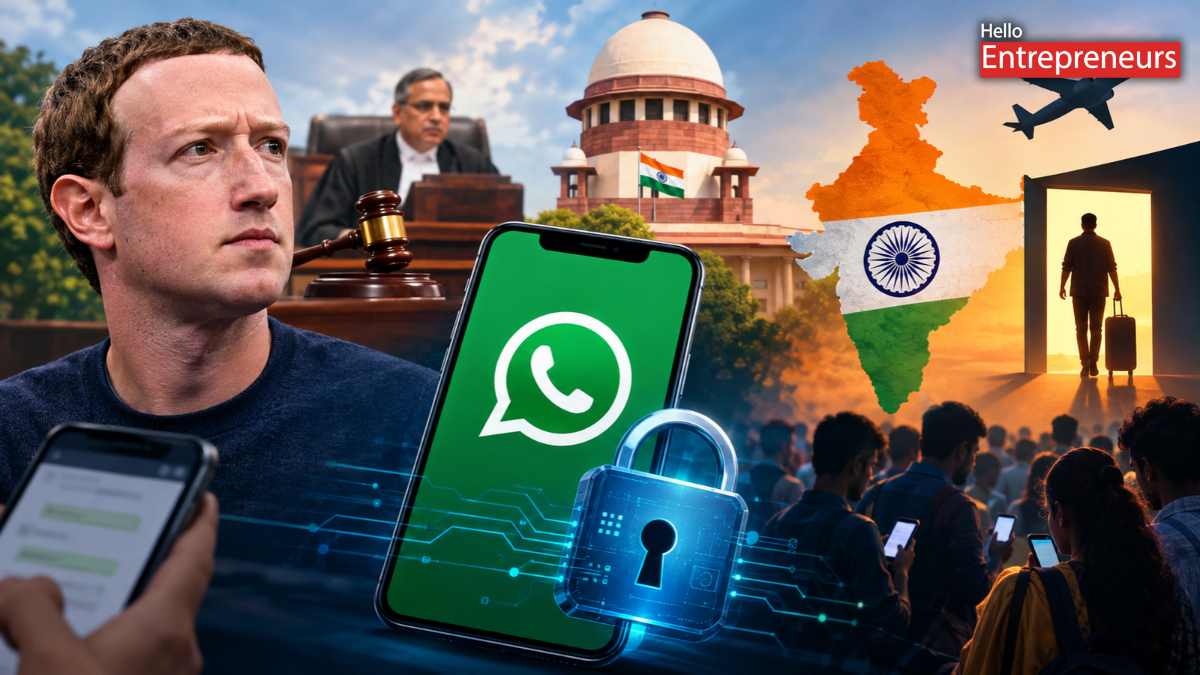
New Delhi: According to one of the screenshots showing an RSS showing WhatsApp’s support for encryption, the messaging app has threatened to exit India’s market due to these regulations. The post, which is in the line, “Your views ….”, features Facebook CEO Mark Zuckerberg with a government building in the background. According to this text, WhatsApp informed the Delhi High Court that it may be forced to shut down operations in India due to the issue of traceability. On top of that is a summary created by Grok, X’s AI chatbot, that states public opinion is split and that it may be wrong.
There’s a genuine source to the claim but it’s mis-timed and mis-framed. The comment comes from a court hearing in Delhi in which WhatsApp’s counsel, Tejas Karia, gave notice to the court that “What’sApp goes” if it’s asked to decrypt. The statement was made in the presence of a bench presided over by Acting Chief Justice Manmohan in the wake of petitions filed by WhatsApp and Meta, the Tribune reported. This hearing was held in April 2024. The argument was heard on a pending case. It was not a press release or a Facebook board dictorial or a Zuckerberg statement.
The controversy revolves around the Information Technology (Intermediary Guidelines and Digital Media Ethics Code) Rules, 2021. Rule 4(2) requires large messaging services to enable identification of the first originator of a message. Dice rules are applicable to platforms having 5+ million users. The requirement kicks in upon a government or court order. In May 2021, WhatsApp approached court, and in August 2021, Delhi High Court requested Centre’s response to the pleas from Facebook and WhatsApp.
The crux of WhatsApp’s case is the way its system operates. Messages are end-to-end encrypted and are only available to sender and receiver. As the Grok summary says, if someone could find the first message sender, then that would be either a compromise on the encryption mechanism or a huge data store. The regulation forces WhatsApp to give up its encryption, which “threatens the privacy and free speech of hundreds of millions of users,” the company has stated. It has also contended that the device wouldn’t even be extremely effective. Many users share content from other sites and social platforms via copy and paste in chat windows and the “originator” might not be the one that originally created the message. Traceability could be fakeable, the company has warned, the result of which could be innocent people being blamed for what they didn’t say. The court lawyer added that there is no such rule in any other parts of the world.
The government doesn’t feel that way. Home Minister Rajnath said his government is sure that ‘traceability’ is a must to ban online criminal activities, fake news, hate speech etc. This was generally argued by officials that only serious cases are covered by this and the application of this rule can only be done on lawful order. Whether it is possible to trace without breaking encryption is still up for debate, as the Grok summary references; there are technologists and lawyers who are debating that issue.
Reactions have been polarized with predictable divisions online. A select few rejoice at the thought of WhatsApp’s departure and hope this move to Indian apps can happen. Some believe that encryption is what makes them feel secure using the service for their personal communications, families and small-business transactions. India is what is considered as WhatsApp’s major market, and if they decide to truly pull the plug on the service there, they would end up impacting a much larger user base. I didn’t see anything that indicated one was underway.
There is also unchecked material from the viral summary. It brings the discussion back to government tracking of Starlink, but I cannot find any reports that correlated the two. The Grok text isn’t an article, but a summary of people’s posts on X written by a machine and can be incorrect.
I couldn’t locate any precedent setting example where the case has resulted in a ruling that puts WhatsApp between a rock and a hard place. The “exit” line was simply a side issue that was made because of a legal point. It is not a plan.

