



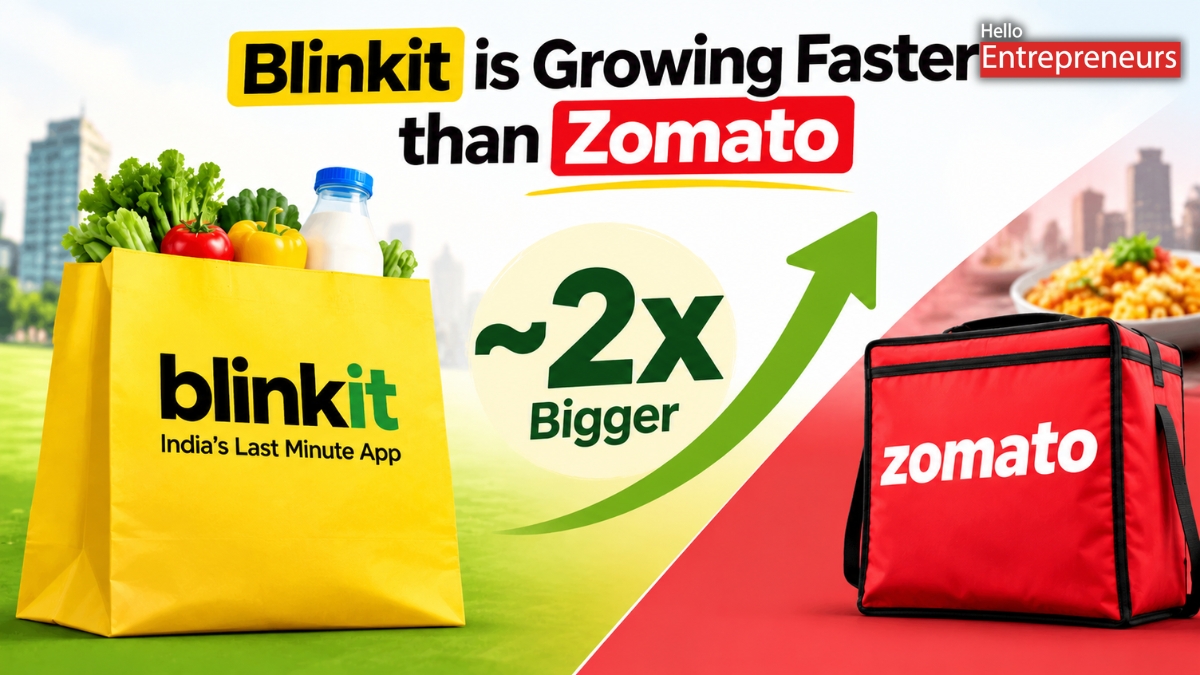
New Delhi: Zomato’s parent, Eternal, has spent years reminding investors that it started as a food delivery company. Its latest quarterly numbers make that harder to remember. Blinkit, the quick commerce arm, did ₹20,940 crore in net order value (NOV) in the quarter ended September 30. Food delivery did ₹11,445 crore. Blinkit is now handling nearly twice the volume of the business that gave the company its name.
The growth gap is wide. Blinkit’s NOV rose 79.3% from a year earlier and 22.2% from the previous quarter. Food delivery grew 21.5% year on year and 6.3% quarter on quarter. That’s a decent number for a mature business, and the company says it’s the fifth straight quarter of faster growth. But it’s a different league from Blinkit’s.
The customer base shows the same shift. Blinkit averaged 37 million monthly transacting customers, against 28 million for food delivery, and it processed about 399 million orders in the quarter. Stores are the engine. Blinkit added 308 net new stores to reach 2,751, and the average store did roughly ₹9 lakh of NOV a day, up from ₹7.7 lakh a year ago. More stores, each selling more.
Management isn’t slowing down. The letter now guides to more than 3,500 stores by March 2027 and about 5,000 by March 2028. The earlier target was 3,000.
The revenue figure needs a caveat
Blinkit’s adjusted revenue jumped 94% to ₹19,152 crore, which looks enormous next to food delivery’s ₹3,879 crore. Don’t read too much into it. Blinkit has been shifting to an inventory-led model, so revenue now includes the full value of goods sold rather than just a marketplace commission. Eternal’s own like-for-like figure for consolidated revenue is 58% growth, not the headline 76%. NOV is the cleaner way to compare the two businesses.
Profit tells a different story
Food delivery is still the money machine. It earned ₹627 crore in adjusted EBITDA, about 5.5% of NOV. Blinkit earned ₹184 crore, or 0.9% of NOV. That’s a real turnaround, since it lost ₹156 crore in the same quarter last year, and margins have improved six quarters running. Still, Zomato’s food business earns more than three times as much profit on roughly half the sales.
Growth in Blinkit is also slowing in percentage terms, even as it gets bigger. NOV growth was 137% two quarters ago a year back, 86% in the June quarter and 79% now. Management puts that down to a larger base, which is fair, and says new stores should pick the pace up again. It also says it’s tracking ahead of its 60% three-year growth guidance but won’t raise it yet.
The cash cost
Consolidated adjusted EBITDA rose 197% to ₹666 crore, and net profit came in at ₹125 crore, up 92%. But cash fell by ₹1,813 crore to ₹16,475 crore. Eternal blames a seasonal build-up in working capital: Blinkit stocked up ahead of the festive season, and the food delivery quarter ended at a point in the restaurant settlement cycle that temporarily lowered payables. Capital spending also climbed to ₹941 crore from ₹417 crore a year earlier. Both explanations are plausible, though fast expansion tends to keep consuming cash.
The odd footnote
Founder Deepinder Goyal used the letter to unveil Dark, a privacy-focused AI chat product built on fine-tuned open-weight models with end-to-end encryption, aimed at power users. He says it should launch globally “hopefully” within 2026. Shares reportedly dipped slightly in early trading, according to a summary of posts on X, though that summary carried its own warning that it can make mistakes.
The bottom line
Blinkit is clearly the bigger growth story, and it’s now profitable on an adjusted basis. But the profit still comes mostly from food delivery. The question for the next few quarters is whether Blinkit’s margins keep rising while it adds stores this fast.

