



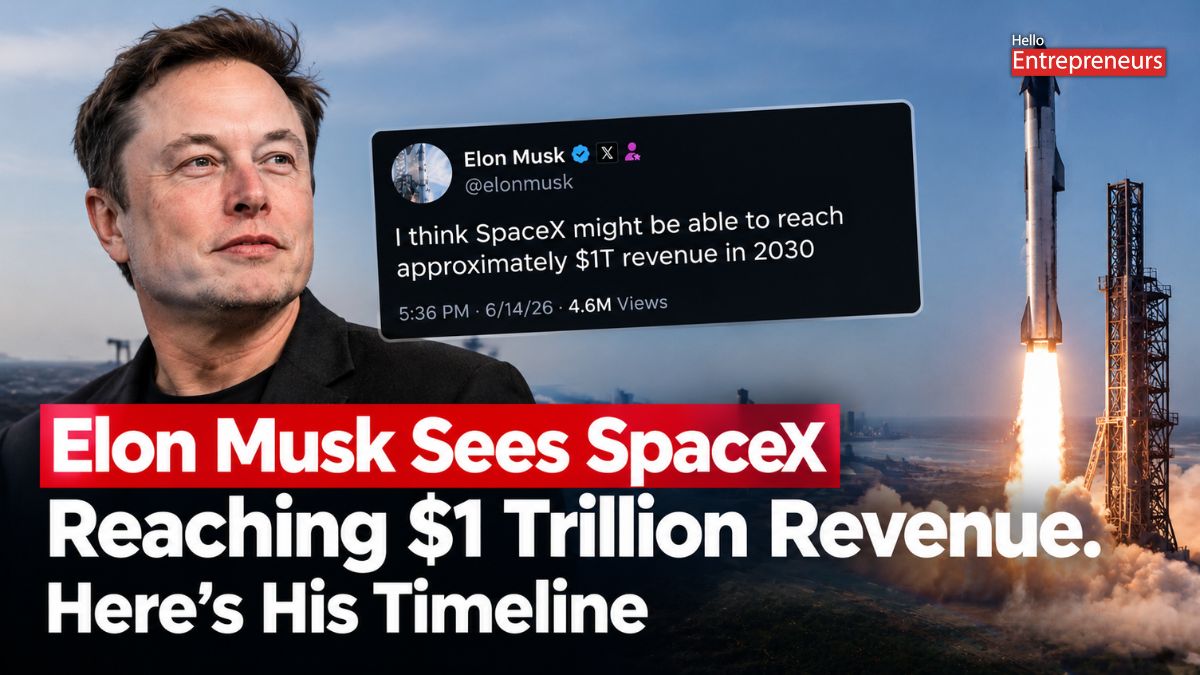
New Delhi: Elon Musk has brought SpaceX’s ambitious financial future into focus after suggesting that the company could generate $1 trillion in annual revenue by 2028. The prediction comes as the rocket and satellite company reports rapid growth in Artificial Intelligence (AI) and satellite internet, alongside fresh discussions about a potential merger with Tesla.
On October 21, Musk wrote on X, “As crazy as this sounds, $1T in SpaceX revenue in 2028 is no longer impossible.” He said SpaceX might reach approximately $1 trillion in revenue by 2030.
The revised timeline comes as SpaceX reports strong financial results, giving investors fresh numbers against which to assess Musk’s ambitious projection.
SpaceX Revenue Jumps 161% as AI Business Expands
SpaceX reportedly generated $14.58 billion in revenue for the third quarter of 2026, up 161% year-on-year and above analysts’ expectations of $12.72 billion. The company also recorded a net profit of approximately $4.4 billion, reversing a loss of around $1.05 billion in the same quarter last year.
AI-related operations have emerged as a major contributor to this growth. SpaceX has been generating revenue by renting data-centre computing capacity to AI developers, while Starlink continues to expand its satellite internet business.
During an earnings discussion, Musk projected that SpaceX could reach an annual recurring revenue run rate of between $500 billion and $1 trillion by the end of 2027. This is a separate forward-looking estimate from his statement about potentially generating $1 trillion in revenue in 2028.
Annual recurring revenue, or ARR, estimates the yearly value of recurring business based on a current revenue run rate. It is not the same as revenue actually recorded over a full financial year.
From $14.6 Billion Quarterly Revenue to $1 Trillion
The scale of Musk’s ambition becomes clearer when compared with SpaceX’s reported quarterly results. Its third-quarter revenue of approximately $14.6 billion represents an annualised pace of around $58.4 billion, assuming the same level of revenue in each quarter.
A $1 trillion annual revenue target would be more than 17 times that annualised figure. This comparison is illustrative rather than a forecast, as quarterly revenue can fluctuate and the company’s business mix may change.
SpaceX’s growth prospects depend on several factors, including the expansion of Starlink, demand for AI computing capacity, launch services and the development of new space infrastructure. However, scaling these businesses will require substantial investment and continued customer demand.
Tesla Merger Speculation Adds Another Dimension
Musk’s revenue projection has emerged alongside discussions about a possible Tesla–SpaceX merger. Both companies have reportedly formed special committees to examine a potential combination. Musk called the idea a good one but indicated that the decision rests with the committees and shareholders. No final merger terms have been confirmed.
A combination could bring together Tesla’s electric vehicles, robotics and AI ambitions with SpaceX’s satellite connectivity, launch capabilities and computing infrastructure. However, the potential benefits and financial implications remain uncertain until more details emerge.
What Are Users Saying on X?
Social-media reactions reflect a mix of excitement about Musk’s space ambitions and curiosity about the financial implications of his companies’ plans.
Michael (@EmptyRogers) wrote, “Mars has never been closer,” reflecting enthusiasm for SpaceX’s long-term exploration ambitions.
Chansoo Byeon (@Chansoo) joked about the potential Tesla–SpaceX merger, writing that Musk wanted to “merge 3 HR into 1 HR.” The post referred to Musk’s comments that a merger could be a good idea.
Meanwhile, Twain Enterprises tagged Grok and asked how such a development might affect stock valuations. Another account, Roadster Cat, posted a comment referring to SpaceX’s revenue ambitions.

