



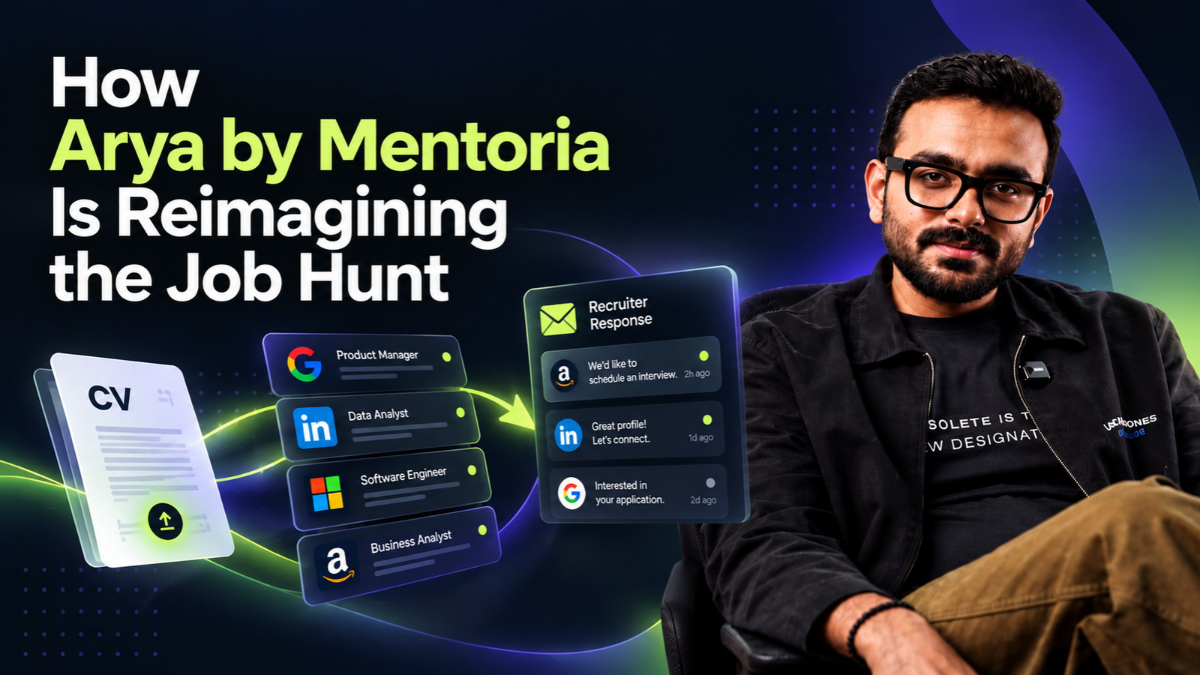
Nikhar Arora on how AI-powered job discovery, automated applications and personalised recruiter outreach are changing the way candidates navigate India’s competitive job market.
For many job seekers, finding a job is only half the challenge. The process involves searching across multiple portals, tailoring resumes, filling out application forms, identifying recruiters and following up on unanswered emails. For working professionals, much of this work happens after office hours, turning job hunting into a time-consuming exercise.
Nikhar Arora is Co-Founder of Arya by Mentoria , believes the real problem lies not just in finding suitable opportunities, but in ensuring that applications reach the right people. With its latest features, Arya, positioned as India’s AI Job Hunter, aims to streamline this process by bringing job discovery, application assistance and recruiter communication into one workflow.
Beyond Job Portals: Closing the Gap Between Candidates and Recruiters
While platforms such as LinkedIn and Naukri help candidates discover vacancies, Arora points to a gap between finding a listing and getting a recruiter’s attention. Applications submitted through portals often join large applicant pools, while candidates may lack the contact details or time needed to follow up.
Arya aims to bridge this gap by combining job discovery with direct recruiter outreach. Its rebuilt jobs engine scans more than one million open positions across over 400 platforms in India, including job portals and company career pages. The system consolidates duplicate listings and links opportunities to company records.
The platform also contacts recruiters and hiring managers through personalised emails, tracks engagement with those emails and supports follow-ups. According to Arora, users can reduce job-search time by 80%, saving more than two hours a day.
Automating Applications Without Removing Candidate Control
A key addition is Arya’s Chrome extension, designed to address vacancies that require candidates to complete application forms rather than send emails. The extension autofills applications on platforms including LinkedIn Easy Apply, Lever and Internshala. On Indeed, it assists with the process and highlights the Submit button, leaving the final action to the candidate.
The approach reflects Arora’s broader view of AI in recruitment: repetitive tasks can be automated, but consequential decisions should remain with the applicant.
Candidates define their preferred roles, experience levels, work arrangements, locations and salary expectations. Arya uses these preferences alongside skills and seniority to identify relevant opportunities, explaining why a role matches and highlighting skills that may be missing. Candidates can then refine their preferences when a recommendation does not fit.
Personalised Outreach Instead of Generic Applications
Arya’s recruiter outreach is designed around the individual role and recipient rather than a standard application message. Emails can be directed to hiring managers, function heads or referral contacts, with outreach sequenced to avoid overwhelming recipients.
Candidates can select from five writing styles: Concise, Analytical, Story-driven, Direct and bold, or Strategist. Messages are sent from the candidate’s own Gmail address, while the platform’s email tracking is limited to activity involving emails it sends.
Follow-ups are another part of the process. Depending on the plan, Arya can send up to three follow-up emails over approximately two weeks. The sequence moves from a value-adding reminder to a gentle nudge and, eventually, a polite close. Follow-ups stop when a recruiter responds or an email bounces.
Arora is careful not to present this as a guarantee of responses. Instead, the objective is to improve the chances of an application being noticed through relevant outreach and timely follow-ups.
Keeping AI-Generated Resumes Grounded in Reality
As AI-generated resumes and cover letters become more common, accuracy remains a concern. Arya addresses this through what Arora describes as a “truth bound” approach: the system works with information supplied by candidates rather than inventing achievements, skills or professional experience.
When a resume section is rewritten, candidates can compare the original and revised versions before deciding which to retain. Version history also allows them to revisit earlier resumes, while different writing tones help tailor applications to different roles.
However, Arora emphasises that AI cannot compensate for missing information. Candidates still need to provide concrete achievements, measurable outcomes and relevant details to make their profiles compelling.
The Future of AI in Job Hunting
For Arora, the greatest loss of opportunity often occurs when candidates fail to reach recruiters, rather than solely because of applicant-tracking systems. Arya therefore focuses on making applications more visible while helping candidates manage the process more consistently.
Its Conversations inbox brings recruiter replies into one place, categorises messages and can draft responses. At the same time, candidates retain control over the jobs they pursue, the resume they submit, the final submission of forms and decisions involving interviews, negotiations and offers.
As AI takes on more repetitive work, Arora believes transparency and candidate judgement become increasingly important. The goal, ultimately, is not to replace the job seeker, but to give them more time to focus on the decisions that shape their careers.