



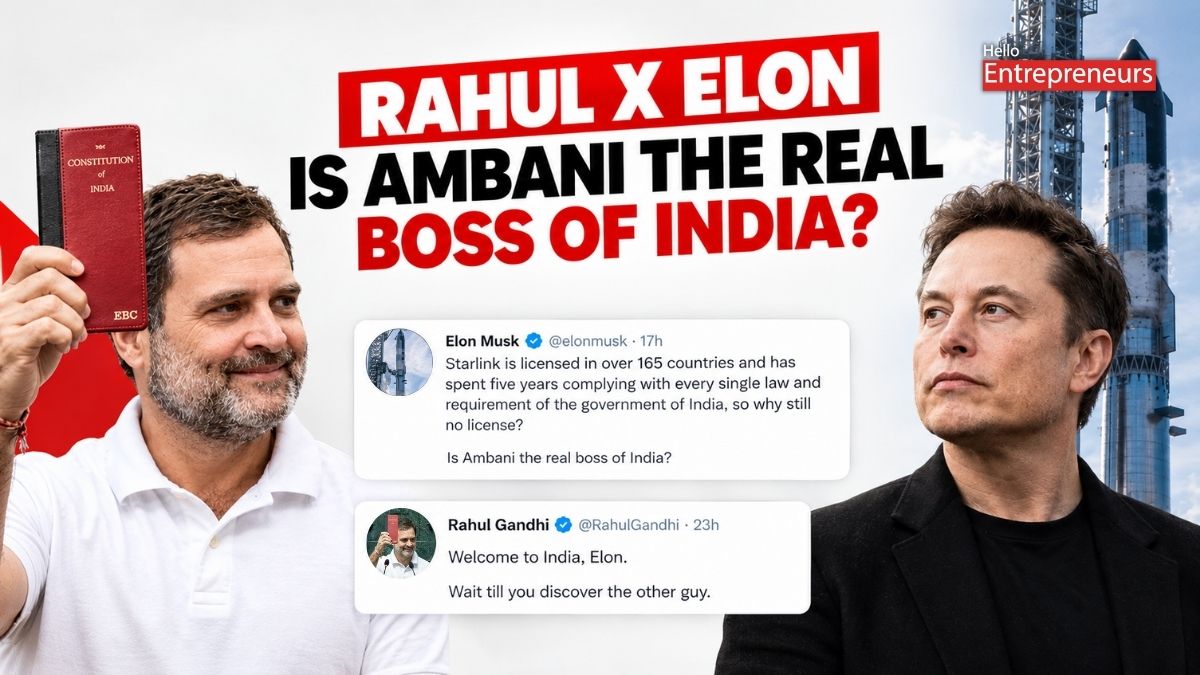
New Delhi, October 9, 2026: Elon Musk’s questions about the delay in launching his satellite internet service, Starlink, in India have sparked a fresh debate about business competition, government approvals and the influence of powerful industrialists. The discussion took a political turn after Congress leader Rahul Gandhi responded to Musk’s remarks about Reliance Industries chairman Mukesh Ambani.
Musk, the chief executive of SpaceX and Tesla, questioned why Starlink was still waiting to begin commercial operations in India despite being licensed in more than 165 countries.
He wrote on X, “Starlink is licensed in over 165 countries and has spent five years complying with every single law and requirement of the government of India, so why still no license? Is Ambani the real boss of India?”
The post came after Musk accused unnamed powerful business groups of blocking Starlink’s entry to protect their market position. In an earlier post, he said, “Unfortunately, we are being blocked by certain oligarchs in order to maintain their monopolistic chokehold on the Indian people. You can guess who they are. This is a crime against the people of India!”
Rahul Gandhi’s Reply Gets Musk’s Attention
Rahul Gandhi responded to Musk’s remarks with a short but pointed message. “Welcome to India, Elon. Wait till you discover the other guy,” the Leader of the Opposition in the Lok Sabha wrote on X.
Although Gandhi did not name anyone, his comment appeared to refer to Adani Group chairman Gautam Adani, whom the Congress has repeatedly accused of receiving favourable treatment from the government. Gandhi also shared an Instagram post featuring Adani and Prime Minister Narendra Modi.
Musk replied to Gandhi, writing, “Thank you, Rahul. This is indeed troubling.”
The exchange quickly attracted attention online, with users discussing the relationship between political power, large business groups and competition in India’s internet market.
Social Media Users Join the Debate
Several users shared strong opinions about the controversy.
Amir Hamja wrote that the dominance of Indian industrialists takes away money earned by ordinary Indians. He argued that the entry of companies such as Starlink could make the Indian market more competitive and reduce the power of existing monopolies.
Another user, Bobbe Dada, claimed that Musk’s comments exposed Ambani’s influence and wrote that “Rahul Gandhi amplifies it.” The user also referred to protests against the BJP and Prime Minister Narendra Modi. These were the user’s political claims and were not independently established facts.
Mary Millben offered a different perspective. Addressing Musk, she wrote that getting close to Rahul Gandhi would not speed up Starlink’s licence approval. She added that companies around the world successfully do business in India and that foreign partnerships require cooperation.
Another account, The Tradesman, shared a Global Times post comparing BYD’s access to international markets with the restrictions it faces in the United States. The post asked whether Musk could be considered the real boss of America, drawing a comparison with his question about Ambani and India.
Musk’s original post also received attention from users who questioned whether the government was protecting powerful business interests over citizens’ needs. One post shared by Musk argued that the government was more interested in protecting “crony capitalists” than citizens.
Government Rejects Allegations of Favouritism
The government has rejected Musk’s claims and said India’s satellite communication approval process is fair and non-discriminatory. The Ministry of Communications stated that security assessments were underway for all three satellite communication operators seeking to enter the market: Starlink, Reliance Jio’s satellite venture and Bharti-backed Eutelsat OneWeb.
Companies must complete the required security checks and spectrum-related approvals before starting commercial services. Therefore, the government maintains that the delay is part of the regulatory process rather than evidence of favouritism.

