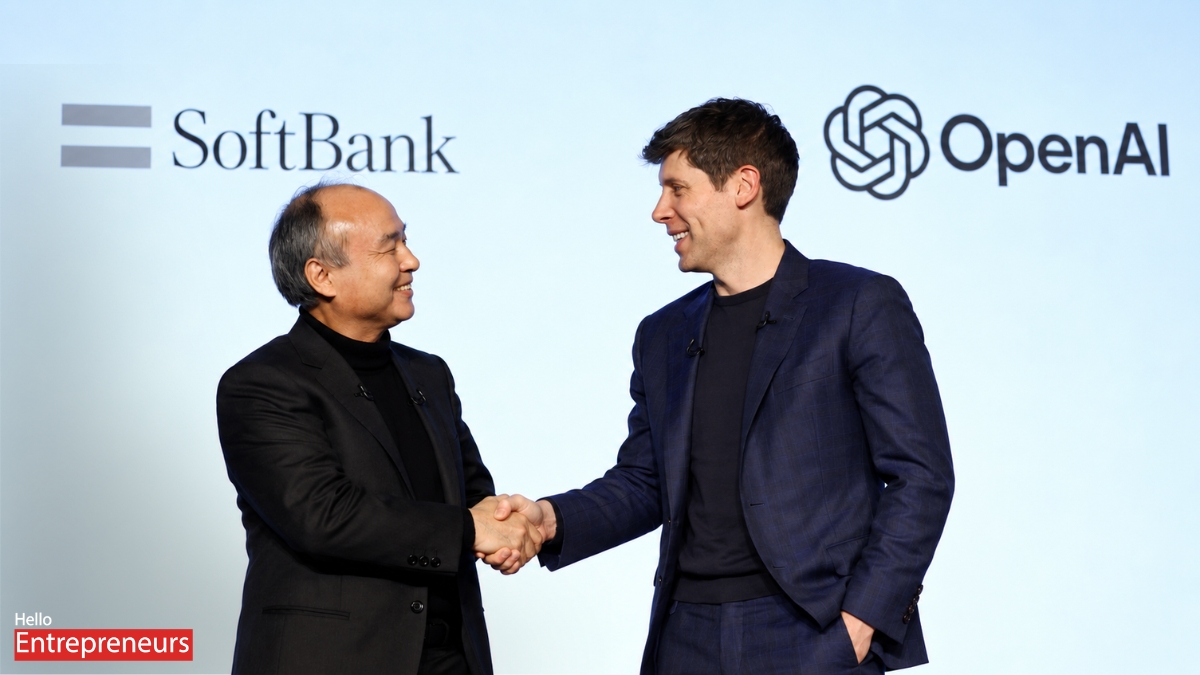








Mumbai: SoftBank has now completed the final $10 billion tranche of its $30 billion follow-on investment in OpenAI, closing a financing commitment that has grown into something much larger than a conventional venture-capital cheque.
The payment, made on October 1 through SoftBank Vision Fund 2, takes SoftBank’s cumulative investment in OpenAI to $64.6 billion, giving it an ownership interest of approximately 13%. The final tranche was funded using proceeds from SoftBank’s foreign-currency senior notes.
And that detail is perhaps more revealing than the $30 billion headline.
Because the AI race is increasingly becoming a story about who can finance the enormous machinery required to keep AI running.
The AI Company Is Starting To Look Like A Utility
OpenAI’s own description of its expansion is telling. In February, the company said its latest financing included $110 billion in new investment at a $730 billion pre-money valuation, with $30 billion coming from SoftBank, $30 billion from Nvidia and $50 billion from Amazon.
By March, OpenAI said it had closed a much larger funding round with $122 billion in committed capital at an $852 billion post-money valuation. The company argued that durable access to computing power was becoming a strategic advantage because consumer adoption, enterprise deployment, developer usage and compute reinforce one another.
That changes the nature of the business.
A traditional software company can scale largely by adding users to existing infrastructure. Frontier AI requires something rather more inconvenient: enormous quantities of chips, electricity, data centres, networking equipment and capital.
The software may be intangible.
The electricity bill certainly isn’t.
$64.6 Billion Is The Number Worth Watching
SoftBank’s OpenAI exposure has accumulated through multiple rounds rather than appearing overnight.
Before the latest $30 billion commitment, SoftBank had already invested $34.6 billion in OpenAI since September 2024. The new investment was divided into three $10 billion tranches in April, July and October 2026.
The final payment also illustrates how financing and AI infrastructure are becoming intertwined.
SoftBank had established a $40 billion bridge facility to support major investments, including OpenAI. It later prepaid the outstanding $25.9 billion balance, and by September 30 cancelled the remaining $10 billion of undrawn capacity. SoftBank said all borrowings under that bridge facility had been repaid.
That is a healthier-looking financing structure than simply leaving the bridge debt hanging around, but it also demonstrates the sheer financial engineering required to support today’s AI ambitions.
The Infrastructure Behind The Investment
The connection between SoftBank and OpenAI goes beyond equity.
The two companies are also central partners in Stargate, the infrastructure initiative announced in 2025 with an intended $500 billion investment over four years in U.S. AI infrastructure. SoftBank has financial responsibility for the project, while OpenAI has operational responsibility.
In January 2026, OpenAI and SoftBank also announced a partnership involving SB Energy, including a $1 billion investment by the two companies and an initial 1.2 GW data-centre lease for OpenAI.
OpenAI subsequently said its Stargate effort had surpassed its original 10-GW infrastructure target ahead of the 2029 deadline, with more than 3 GW added in a 90-day period.
So the investment is not simply about owning part of an AI company. It sits inside a broader ecosystem involving compute, energy, data centres and financing.
The Positive Side Of Going This Big
There is a rational industrial argument behind the enormous numbers.
Large pools of capital allow OpenAI and its partners to secure computing capacity earlier, build infrastructure at scale and reduce the risk that demand grows faster than available compute. It can also support longer-term projects that would be difficult to finance through ordinary corporate cash flow.
The wider ecosystem can benefit too:
- More data-centre construction creates demand for power, cooling, networking and construction companies.
- Semiconductor and hardware suppliers gain large institutional customers.
- AI developers receive access to greater computing capacity.
- Infrastructure investment can accelerate regional technology and energy projects.
That is the optimistic version of the story.
But The Numbers Also Create A Fragile Dependency
The less comfortable question is what happens if AI economics fail to expand as rapidly as expected.
SoftBank itself identifies OpenAI investment as a material risk and maintains explicit loan-to-value and liquidity policies around its balance sheet. The company says it normally manages LTV below 25%, with a 35% upper threshold under abnormal conditions.
The financing cost is not trivial either. In September, SoftBank raised $11.1 billion through dollar- and euro-denominated senior notes, with reported yields ranging from 7.125% to 9.75%. The proceeds helped fund the final OpenAI tranche.
That does not mean the investment is inherently unsustainable. It does mean the financial architecture deserves almost as much attention as the AI models themselves.
After all, the machines may be intelligent.
The balance sheet remains stubbornly mathematical.
The Bigger Shift Is Already Underway
SoftBank’s completed $30 billion commitment is therefore less interesting as a single funding event than as a snapshot of where frontier AI is heading.
OpenAI is simultaneously becoming a model developer, cloud-scale computing customer, infrastructure partner and platform business. SoftBank, meanwhile, is tying its investment strategy increasingly closely to the physical infrastructure needed to make that AI economy possible.
The future of AI may still be written in code.
But increasingly, it is being financed in bonds, power contracts, data centres and gigantic capital commitments.
And that may be the most important development hidden inside SoftBank’s $30 billion cheque.
Read More: India’s Semiconductor Race